B2B SaaS Conversion Rate Benchmarks: What the Data Actually Tells You
A B2B SaaS website can attract thousands of visitors every month and still struggle to generate qualified pipeline. The problem isn’t always traffic. Sometimes, the website fails to turn the right visitors into demo requests, product trials, or paying customers.
That raises an important question: what is a good conversion rate for a B2B SaaS company?
The answer depends on what you’re measuring. A landing page that converts visitors into leads operates differently from a self-serve product that converts free users into paying subscribers. Comparing those percentages without understanding their definitions can lead to the wrong marketing decisions.
This article examines the available data, explains what the benchmarks actually measure, and shows how B2B SaaS companies can use them to improve website performance and revenue generation.
B2B SaaS Conversion Rate Benchmarks at a Glance
There is no single conversion rate that applies to every B2B SaaS business. The following figures come from different datasets and measure different stages of the customer journey.
| Conversion metric | Published benchmark | Research source |
|---|---|---|
| SaaS landing-page conversion | 3.8% median | Unbounce, 2024 report |
| Free-to-paid conversion across surveyed software products | 8% median | ChartMogul and ProductLed, 2026 report |
| Free-trial-to-paid conversion, no credit card required | 18.2% | First Page Sage, 2025 study, organic traffic |
| Free-trial-to-paid conversion, credit card required | 48.8% | First Page Sage, 2025 study, organic traffic |
| Freemium-to-paid conversion | 2.6% | First Page Sage, 2025 study, organic traffic |
Sources: Unbounce, ChartMogul, and First Page Sage.
1. What Is a Good B2B SaaS Website Conversion Rate?
The 2024 Unbounce Conversion Benchmark Report reported a 3.8% median conversion rate for SaaS landing pages.
That benchmark is useful for understanding landing-page performance, but it should not automatically become the target for every page on a SaaS website.
Consider the difference between these actions:
- Downloading a gated industry report.
- Subscribing to a newsletter.
- Registering for a free trial.
- Requesting a product demonstration.
- Booking a consultation with the sales team.
Each action requires a different level of commitment. A downloadable report typically demands less from a visitor than scheduling a sales meeting or beginning a product evaluation.
The audience also matters. A page attracting early-stage researchers may convert differently from a page targeting buyers who have already shortlisted vendors.
For this reason, the most useful benchmark is one that matches the conversion action, acquisition channel, audience, and buying stage you’re measuring.
Landing-page conversion benchmarks by traffic source
Unbounce’s research also illustrates how conversion rates vary by acquisition channel.
Its SaaS findings include the following observations:
- SaaS landing pages had a median conversion rate of 5.1% for Google paid search traffic.
- Instagram paid social traffic recorded a 9.2% median conversion rate.
- Facebook paid social traffic recorded a 3.5% median conversion rate.
- Email was the strongest-performing channel in its SaaS analysis.
- Mobile accounted for 79% of SaaS landing-page visits in the dataset.
These findings come from Unbounce’s particular landing-page dataset. They should not be interpreted as universal conversion rates for all B2B SaaS companies or as proof that one channel will outperform another in every market.
The practical takeaway is to evaluate each channel against its own conversion performance and lead quality.
A channel generating fewer conversions can still produce more revenue if its visitors are more likely to become qualified opportunities or customers.
2. Free-Trial-to-Paid Conversion Benchmarks
Free trials are a common acquisition model for SaaS businesses that allow prospects to experience a product before purchasing it.
However, the percentage of trial users who become paying customers varies considerably.
In its September 2025 report, First Page Sage analysed data from 86 SaaS companies collected between Q1 2022 and Q3 2025. The sample comprised 71% B2B and 29% B2C companies.
Its organic-traffic benchmarks were:
| Free-trial model | Visitor-to-trial conversion | Trial-to-paid conversion |
|---|---|---|
| Free trial without a required credit card | 8.5% | 18.2% |
| Free trial requiring a credit card | 2.5% | 48.8% |
The distinction between these two models is important.
Requiring a credit card before a trial can discourage some visitors from signing up, while those who do register may have stronger purchase intent. A trial without a credit-card requirement can attract more users, but a smaller proportion may eventually pay.
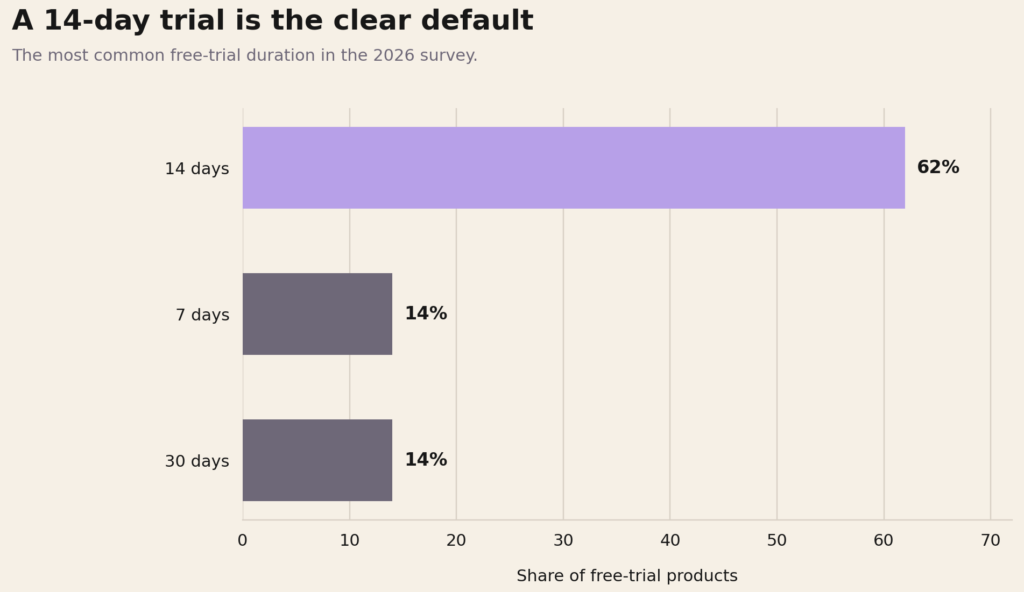
These numbers are specific to First Page Sage’s dataset. They are not a guarantee of what another SaaS business should expect.
What does newer SaaS conversion research show?
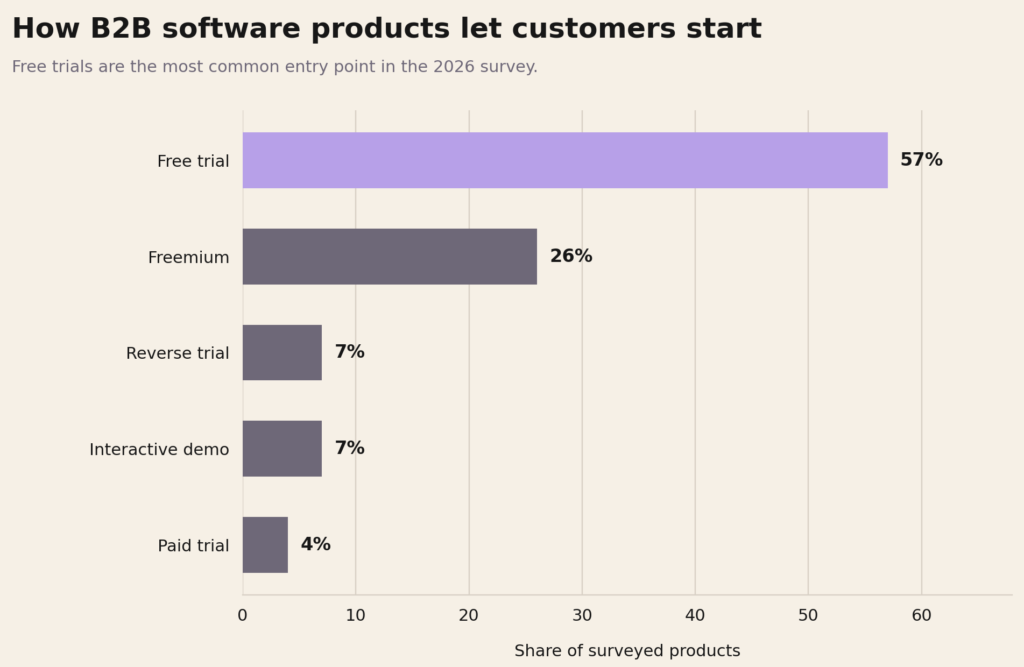
The 2026 ChartMogul and ProductLed Conversion Report analyzed 200 B2B software products.
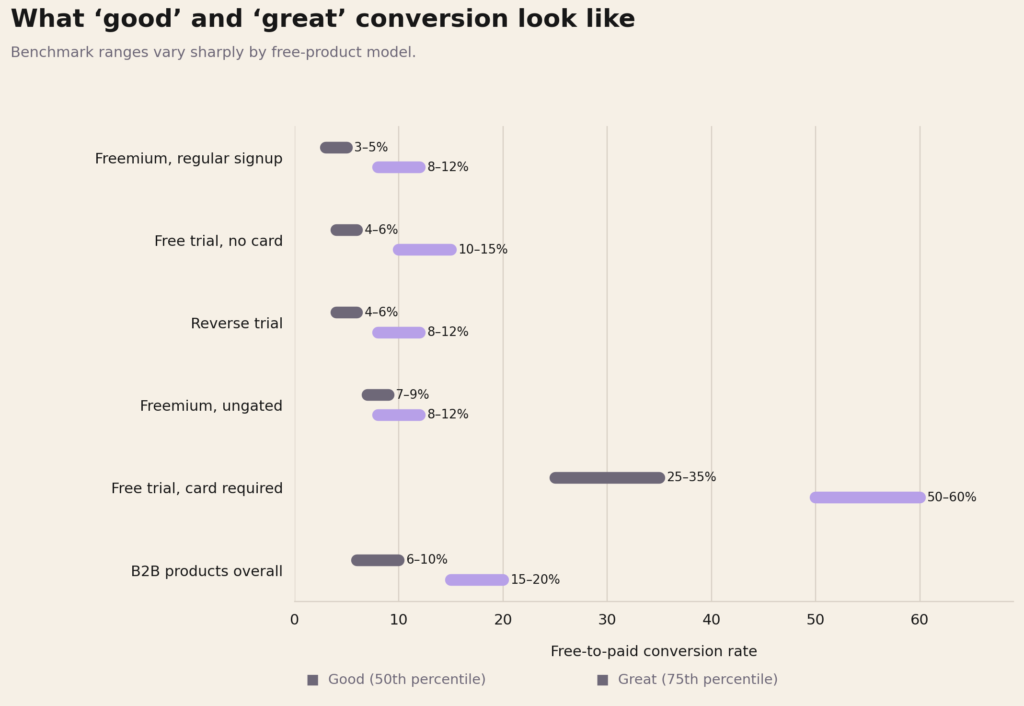
The study reported a median free-to-paid conversion rate of 8% across the products surveyed. It also examined how free-trial models and credit-card requirements affect conversion.
At first glance, its findings may appear different from First Page Sage’s figures. However, the studies are not identical. First Page Sage reported trial-to-paid conversion for organic traffic, while ChartMogul’s study used a different sample and measurement framework.
Differences in samples, definitions, and product mix can produce different benchmarks. Neither figure should be used without its original context.
What should SaaS marketers do with these findings?
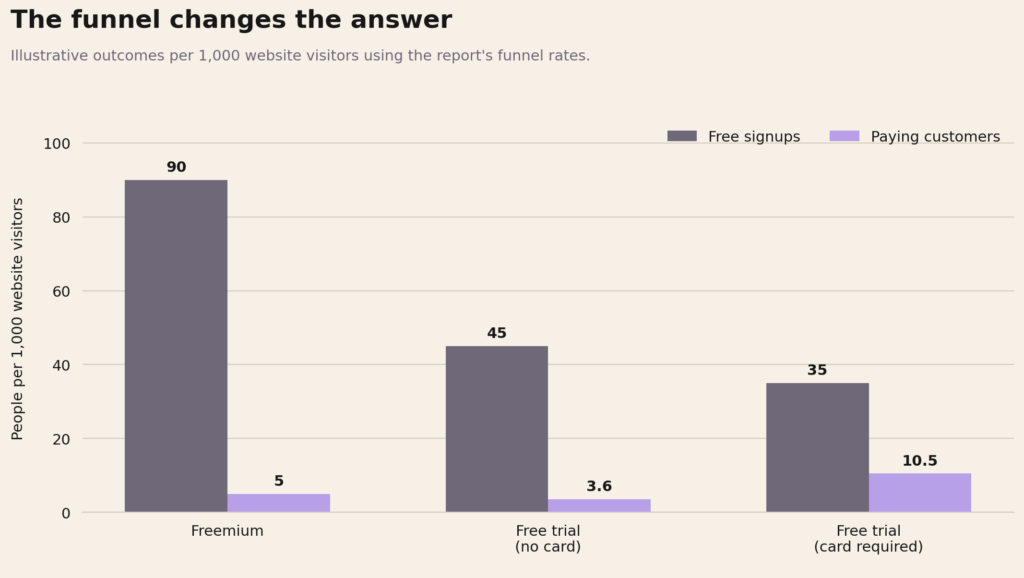
Measure the entire funnel rather than optimising for trial conversion alone. A credit-card requirement might increase the proportion of trial users who pay while reducing the number of people who start a trial. The right model depends on total paying customers, acquisition costs, customer value, and retention.
3. Freemium Conversion Rate Benchmarks
Freemium products allow users to access a free version of a product, usually with limitations on functionality, usage, or collaboration.
This model can work well when users can experience value without speaking to sales or committing to a subscription.
First Page Sage’s 2025 research reported a 2.6% freemium-to-paid conversion rate for organic traffic.
The 2026 ChartMogul Conversion Report also highlights the variation between individual products. Its findings show that a median alone does not describe the full distribution of free-to-paid conversion rates.
This matters because a freemium product can attract a large number of users while converting only a small proportion into paying customers.
For example, a freemium product with 10,000 free signups and a 2.6% conversion rate would generate 260 paying customers, assuming the rate applies to that signup cohort and measurement period.
That calculation illustrates the relationship between volume and conversion. It is not a forecast of what every freemium business will achieve.
When evaluating freemium performance, SaaS teams should also measure:
- Activation rate.
- Time to first value.
- Percentage of users reaching feature or usage limits.
- Free-to-paid conversion by signup cohort.
- Paid customer retention.
- Revenue per free signup.
- Customer acquisition cost and lifetime value.
These metrics help explain whether the free product is attracting the right users and whether those users have a credible path towards becoming paying customers.
4. Why SaaS Conversion Rates Differ by Business Model
The difference between a free trial and freemium isn’t simply the number of days someone can use a product. Each model creates a different customer journey.
Free trials
A free trial works best when users can experience the product’s value within a relatively short period.
For example, a project management platform might allow a team to create a workspace, invite colleagues, and manage its first project during a 14-day trial.
The challenge is helping users reach that outcome before the trial ends.
Freemium
Freemium allows prospects to explore the product for longer, often without a payment deadline.
The challenge is giving users enough value to become engaged while making the benefits of a paid plan clear. If the free tier already solves the user’s problem, there may be little reason to upgrade.
Sales-assisted SaaS
Enterprise software often involves demonstrations, security reviews, procurement, multiple stakeholders, and longer buying cycles.
For these products, a website conversion may mean a qualified demo request rather than a subscription.
The sales team then has to progress that opportunity through discovery, evaluation, and purchasing.
These differences explain why a SaaS benchmark should always be matched to the business model and conversion event being measured.
5. What Drives B2B SaaS Conversion Rates?
Benchmarks describe outcomes. To improve those outcomes, marketers need to identify the factors influencing the conversion process.
Clear positioning and messaging
Visitors should understand what the product does, who it serves, and why it matters.
A headline focused on a concrete business outcome is generally more useful than a vague statement about innovation or transformation.
For example, a cybersecurity platform could explain how it helps security teams identify vulnerabilities and reduce investigation time instead of relying on broad claims about next-generation protection.
Clear messaging helps visitors decide whether the product addresses their problem.
Relevant landing pages
A single generic landing page cannot effectively address every audience, industry, or use case.
A SaaS business serving healthcare, financial services, and manufacturing may need separate pages that explain the product’s relevance to each sector.
These pages should reflect genuine differences in customer needs, workflows, compliance requirements, and buying criteria rather than simply replacing industry names in otherwise identical copy.
Credible proof
B2B buyers often need evidence before committing to a product evaluation.
Relevant proof may include customer case studies, measurable outcomes, implementation details, integrations, security documentation, and customer testimonials.
The strongest evidence answers specific buyer questions. A generic claim that hundreds of businesses trust a product is less informative than a case study explaining how a comparable company addressed a measurable problem.
A frictionless user experience
Long forms, unclear calls to action, slow pages, and confusing navigation can interrupt the journey from interest to conversion.
Review the experience on mobile devices as well as desktop. Unbounce’s research found that mobile accounted for most SaaS landing-page visits in its dataset.
Tools such as Microsoft Clarity can help teams investigate user behaviour through session recordings and heatmaps. Google’s Core Web Vitals documentation provides guidance for evaluating loading performance, responsiveness, and visual stability.
Neither tool automatically identifies the correct fix. The goal is to find friction that affects meaningful user actions.
Effective onboarding
A signup is not the same as an activated user.
For a free-trial product, onboarding should help users reach a meaningful outcome as quickly as possible. Depending on the product, that might mean connecting an integration, importing data, inviting teammates, or completing a first workflow.
Product-led growth research, including ProductLed’s product-led growth resources, provides additional context for understanding activation and free-to-paid conversion.
The principle is straightforward: conversion depends on what happens after acquisition, not just on the marketing page that generated the signup.
6. How to Calculate Your SaaS Conversion Rate
Before comparing performance with industry benchmarks, define the conversion event and the denominator.
For a website conversion rate:
Website conversion rate = Conversions ÷ Eligible visitors × 100
For example, if a SaaS website receives 20,000 eligible visitors and generates 600 demo requests:
600 ÷ 20,000 × 100 = 3%
The website’s visitor-to-demo-request conversion rate is 3%, assuming those figures use the same reporting period and consistent visitor definitions.
For a trial-to-paid conversion rate:
Trial-to-paid conversion rate = Paying customers from a trial cohort ÷ Trial users in that cohort × 100
If 120 users start a trial and 18 become paying customers within the defined conversion window, the rate is 15%.
The cohort and time window matter. If some users have only just started their trials, they may not have had enough time to convert. Comparing mature cohorts with recently acquired users can distort the results.
Choose the right analytics events
SaaS teams should define key actions consistently across their analytics and CRM systems.
For website measurement, Google Analytics documentation explains the distinction between key events in Analytics and conversions used for advertising measurement.
A practical measurement setup might track:
- Landing-page visits.
- Demo form submissions.
- Qualified leads.
- Trial registrations.
- Product activation.
- Paid subscriptions.
- Sales-qualified opportunities.
- Closed-won revenue.
The exact events will depend on the sales model. A self-serve SaaS product and an enterprise SaaS platform should not necessarily use the same primary conversion event.
Where possible, connect website and product analytics to CRM data. This allows marketing teams to distinguish between a form submission and a lead that ultimately becomes revenue.
For a wider measurement framework, TechGranduer’s guide to tracking AI traffic with GA4, Search Console, and server logs explains how acquisition-source data can be interpreted alongside business outcomes.
7. How to Improve B2B SaaS Conversion Rates
Once measurement is reliable, conversion optimization becomes a prioritisation problem.
The objective isn’t to increase every conversion percentage. It is to identify the point in the funnel where an improvement will produce the greatest commercial benefit.
Step 1: Find the largest drop-off
Map the journey from visitor to lead, trial, opportunity, and customer.
Look for stages where users abandon the process or where conversion rates differ significantly across channels, campaigns, landing pages, or customer segments.
A high-volume landing page with a weak demo conversion rate may deserve attention before a low-traffic page with a similar percentage.
Step 2: Investigate the cause
Use analytics, user feedback, session recordings, sales-call notes, and customer interviews to understand why visitors are not progressing.
Possible causes include unclear positioning, low-intent traffic, missing trust signals, an unnecessarily long form, or a mismatch between the promised value and the actual product experience.
Avoid assuming that every low conversion rate is a copywriting problem.
Step 3: Develop a specific hypothesis
A useful experiment tests a clear explanation for the observed problem.
For example:
Hypothesis: Prospects are hesitant to request a demo because the page doesn’t explain what happens during the meeting.
Test: Add a short explanation of the demo agenda, expected duration, and relevant product workflows.
Primary metric: Qualified demo requests per eligible visitor.
Guardrail metrics: Lead quality, meeting attendance, and sales acceptance rate.
This approach is more informative than changing a headline, button colour, and form length simultaneously and then guessing which change caused the result.
Step 4: Measure business impact
A higher conversion rate does not always translate into higher revenue.
Suppose a landing-page redesign increases demo requests by 20%, but the additional leads are poorly qualified. The sales team may spend more time on unsuitable prospects without generating proportionally more opportunities.
Evaluate conversion alongside lead quality, opportunity creation, sales-cycle length, customer acquisition cost, and revenue.
Step 5: Continue testing
Conversion optimization should be an ongoing process rather than a one-off website redesign.
Prioritise experiments based on expected impact, confidence in the hypothesis, implementation effort, and the amount of traffic available.
For lower-traffic B2B websites, use qualitative evidence and longer observation periods where appropriate. A handful of additional conversions is not enough to establish that a small change caused a reliable result.
8. How SEO Can Improve SaaS Website Conversions
SEO and conversion optimization are closely related, but they solve different problems.
SEO helps relevant prospects discover a business through search. Conversion optimization helps those visitors take the next useful action.
A SaaS website may attract substantial organic traffic while generating few qualified opportunities if its pages target informational searches that don’t match the product’s audience or buying stage.
A more commercially useful SEO strategy connects search intent with the right landing page and conversion path.
For example:
| Search intent | Example content | Appropriate next step |
|---|---|---|
| Problem awareness | How to reduce manual reporting | Practical guide or relevant solution page |
| Solution research | Best reporting automation software | Product comparison or use-case page |
| Vendor evaluation | Reporting software for finance teams | Product demonstration or consultation |
| Product evaluation | Product pricing and integrations | Trial signup or sales conversation |
The objective is not to force every visitor into a demo request. It is to provide a relevant next step that reflects the visitor’s needs.
This requires more than publishing blog posts. It involves search-intent research, technical SEO, useful landing pages, clear internal linking, credible proof, and reliable conversion tracking.
TechGranduer’s digital growth strategy for B2B companies explains how SEO, content, website performance, and technology can work together to support measurable business growth.
For SaaS businesses, the most valuable outcome is not simply more organic sessions. It is more qualified pipeline and revenue from search.
9. How to Build a Meaningful SaaS Conversion Benchmark
Published reports provide useful context, but they cannot tell you precisely what your own company should achieve.
To build a meaningful internal benchmark, standardise the following:
Metric definition: Decide exactly what counts as a conversion.
Audience: Separate relevant customer segments, such as small businesses and enterprise buyers.
Acquisition channel: Compare organic search, paid search, referrals, email, and other channels separately where the data supports it.
Business model: Distinguish demo-led, sales-assisted, free-trial, and freemium journeys.
Measurement window: Define how long users have to convert and how cohorts are assigned.
Lead quality: Track whether conversions progress to qualified opportunities and paying customers.
Revenue impact: Connect marketing activity to pipeline, closed-won revenue, customer acquisition cost, and retention.
Review these metrics regularly, but avoid changing targets simply because another company’s published benchmark is higher.
External research tells you what other datasets report. Your own funnel tells you where your business has room to improve.
TechGranduer’s SEO strategy evaluation framework provides a practical way to assess whether an organic growth plan connects keyword targeting, website improvements, measurement, and business outcomes.
Conclusion: Focus on the Conversions That Generate Revenue
B2B SaaS conversion rate benchmarks are useful when they help you identify performance gaps and set realistic expectations. They become misleading when landing-page signups, trial-to-paid conversion, and qualified lead generation are treated as the same metric.
The available research shows substantial variation between SaaS products, acquisition channels, and free-product models. That variation makes context more important than any single headline percentage.
Start by defining your conversion events, validating your analytics, and identifying the biggest drop-off in the customer journey. Then improve the pages, messaging, onboarding experiences, and sales processes most likely to influence qualified pipeline.
For SaaS companies investing in SEO, the ultimate objective should be to connect search visibility with measurable commercial outcomes. More traffic is useful only when it reaches the right audience and creates a credible path towards revenue.
At TechGranduer, we approach SaaS growth by connecting search visibility, website performance, and conversion measurement to business outcomes. The goal is not simply to increase traffic, but to help turn relevant demand into qualified pipeline and revenue.