
Digital Growth Strategy: The Complete Guide for SMEs and B2B Companies
How SEO, website development, and technology consulting work together to build a durable growth engine, and how to sequence them correctly for your business.
In this guide, you’ll learn:
- What Is a Digital Growth Strategy?
- Preparing for Growth
- The Economics of Digital Growth
- Growth Planning
- Execution
- Auditing and Maintenance
- Conclusion
- FAQs
What Is a Digital Growth Strategy?
A digital growth strategy is a coordinated plan for using search visibility, content, website performance, technology, and measurement to create sustainable business growth. Instead of treating SEO, website development, and technology consulting as separate projects, it connects them to the same business goals and buyer journey.
Most guides on digital growth fall into one of two traps. Either they’re purely tactical meaning: ten SEO tips, five website hacks with no strategic backbone, or they’re so generic they could apply to any business in any country, which means they apply usefully to none.
TechGranduer sits at an cusp: a digital growth agency running three service lines.
- SEO strategy
- Website Development.
- Technology consulting.
For businesses across SaaS, healthcare, fintech, fitness, retail, insurance, and real estate. That combination is the whole point of this guide. Most agencies sell one of these three things and very few explain why they work best together, and fewer still show a business owner or marketing lead exactly how to think about sequencing them.
This guide is built to do two things: teach the strategic thinking behind a real digital growth program and rank for the terms your prospects are searching before they’re ready to talk to sales.
Digital growth strategy isn’t SEO, or a website, or a piece of technology advice in isolation — it’s the sequencing and interplay between all three.
Preparing for Growth
Before any SEO audit, website mockup, or tech stack review, you need to know three things: who you’re building for, where you currently stand, and what’s realistic given your resources.
Defining Your Buyer, by Industry
A “buyer persona” gets a bad reputation because most are built on guesswork. A useful persona is narrower and duller than that: it’s a cluster of real prospects who share the same problem, the same buying triggers, and the same objections. This matters more than usual for a multi-vertical agency, because the buyer looks completely different depending on the industry:
- SaaS — a marketing lead evaluating whether organic search can reduce paid acquisition costs. Technical, numbers-driven, wants attribution.
- Healthcare — an operations or practice manager who cares about compliance, trust signals, and local visibility more than raw traffic volume.
- Fintech — often a founder or Head of Growth under regulatory constraints, sensitive to site security and credibility signals.
- Fitness — often a local-first business owner who needs bookings and local search visibility more than a content program.
- Retail — a commercial or e-commerce manager focused on conversion rate and product-page SEO as much as blog content.
- Insurance — a marketing director dealing with long consideration cycles and heavy legal review on published content.
- Real estate — an agency principal or broker who needs local SEO and lead capture more than thought leadership.
The practical implication: TechGranduer shouldn’t run one generic “digital growth” pitch across all seven verticals. Each needs its own persona brief and, ideally, its own landing page and content cluster.
The Three-Layer Audit
Before recommending SEO, a rebuild, or a consulting engagement, a real audit looks at three layers together, not in isolation.
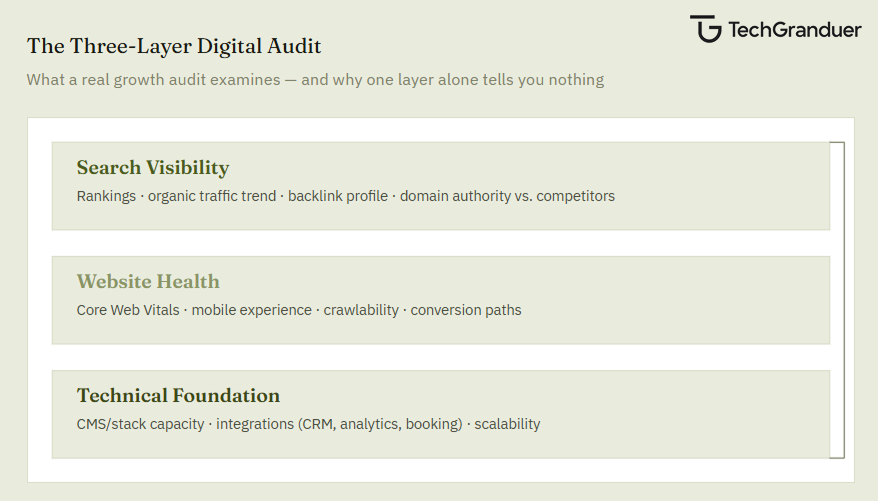
A business with a beautiful, fast website but zero technical SEO foundation won’t rank. A business with excellent SEO content sitting on a slow, unindexable site won’t convert what it does rank.
A well-structured site should also meet baseline accessibility standards beyond being the right thing to do, an accessible site expands market reach and reduces legal risk, a point the W3C’s Web Accessibility Initiative lays out in its business case for accessibility.
And a business running both well on outdated infrastructure will hit a ceiling the moment it tries to scale content or add functionality. This three-layer view is the reason TechGranduer’s three service lines exist together.
A SWOT Built for Digital Growth
Can we just stop Copying a competitor’s strategy “we’ll just do what they did”? It is one of the most common reasons digital growth programs stall. What works for a high-authority SaaS competitor with five years of backlinks won’t work identically for a newer fintech entrant.
- Strengths: existing domain authority, an engaged customer base, unique data, a founder with a strong personal brand.
- Weaknesses: thin technical foundation, no historical content, low site speed, no in-house design or dev resources.
- Opportunities: underserved keyword gaps, emerging regulatory shifts, AI/GEO visibility still wide open in a niche.
- Threats: a well-funded competitor investing heavily in content, algorithm volatility, over-reliance on one acquisition channel.
Setting Realistic Goals
The single biggest expectation-setting conversation TechGranduer needs to have with a new client: a new or low-authority site cannot expect to rank for competitive commercial terms in month one. Realistic goal-setting means separating what you’re building toward from what will actually move in the next 90 days — usually long-tail, lower-competition terms first, with competitive head terms as a 6–12 month outcome.Part 2
The Economics of Digital Growth
Every growth initiative has a cost and an expected return, and different services carry very different cost curves.
What Things Actually Cost
- SEO content: a well-researched, 1,500–2,000 word blog post targeting a mid-competition keyword requires real subject-matter research, on-page optimization, and internal linking: moderate cost, moderate scale.
- Pillar guides: higher upfront cost per piece, but they anchor an entire cluster and compound in value as more pages link to them.
- Website development: the widest cost range of the three: a focused landing page refresh is a very different investment than a full CMS migration with custom integrations.
- Tech consulting: often billed as a retainer or project rather than a per-asset cost, because the deliverable is a decision framework rather than a published page.
The Site Authority and Ranking Effort Curve
It takes disproportionate effort to build the first meaningful layer of domain authority. Independent research backs this up: an Ahrefs correlation study spanning roughly one million search queries found that referring domains and backlink counts correlate more strongly with top-20 rankings than domain-level authority scores alone — meaning link equity has to be earned incrementally, and its impact compounds rather than appearing all at once.
Past a certain point, the curve flattens: a site with stronger link equity, topical relevance, and a proven history of useful content may need less effort to establish visibility for some queries.
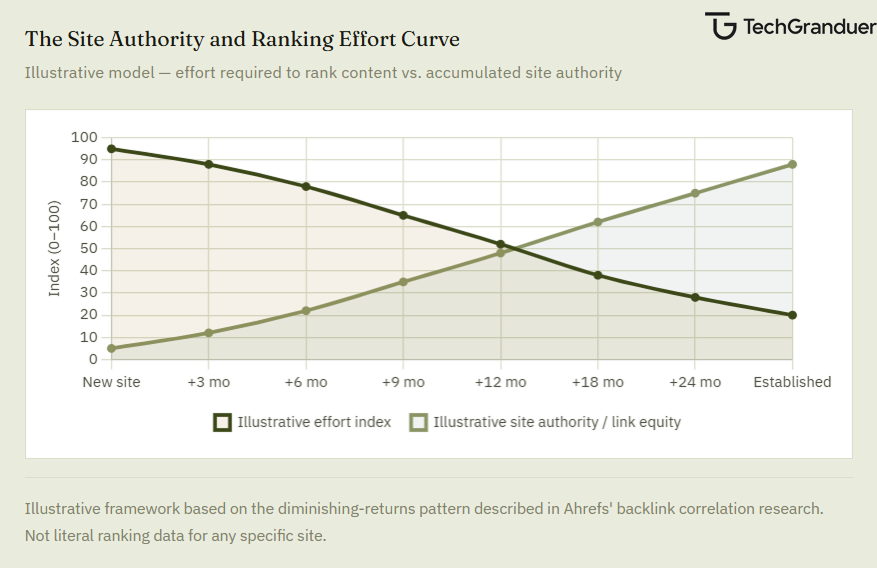
For newer websites, this means the early months of a program should be judged on leading indicators — indexed pages, impressions, keyword position movement, technical health scores — rather than final rankings or conversions, which come later as authority compounds.
Why the Investment Case Keeps Strengthening
The broader investment picture also supports treating digital infrastructure as an operating capability rather than a one-off marketing expense. IDC reported in 2026 that global spending on digital transformation software is on pace to reach $640 billion by 2029, while its broader digital-transformation outlook has projected total DX investment at almost $4 trillion by 2028. These figures cover much more than SEO or websites, but they illustrate the scale of business investment in digital capabilities. IDC’s 2026 analysis provides the more current software-spending context.
Maximizing ROI Across Three Service Lines
Because TechGranduer offers SEO, website development, and tech consulting together, there’s a sequencing decision every client has to make:
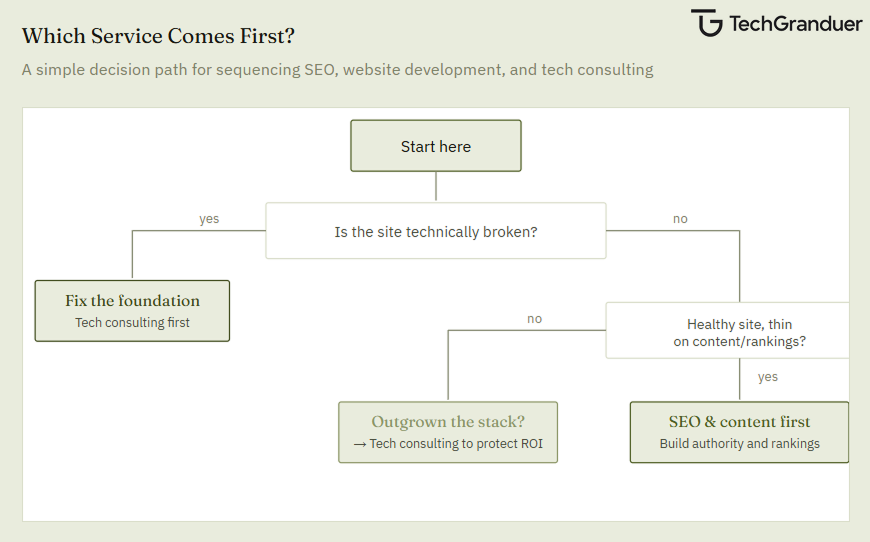
This sequencing logic is itself a strong content angle and a natural bridge into commercial-intent pages — a prospect reading “should I fix my SEO or rebuild my site first” is close to a buying decision.Part 3
Growth Planning
How Buyers Search, by Stage
- Awareness stage: broad, problem-aware searches: “why is my website traffic dropping,” “how to grow an insurance business online.” Goal: build topical authority and capture early interest.
- Consideration stage: comparing approaches: “SEO vs paid ads for SaaS,” “should I redesign my website.” Goal: educate and differentiate TechGranduer’s approach.
- Decision stage: vendor evaluation: “best digital growth agency Belgium,” “SEO agency for fintech companies,” “website development cost.” Goal: convert.
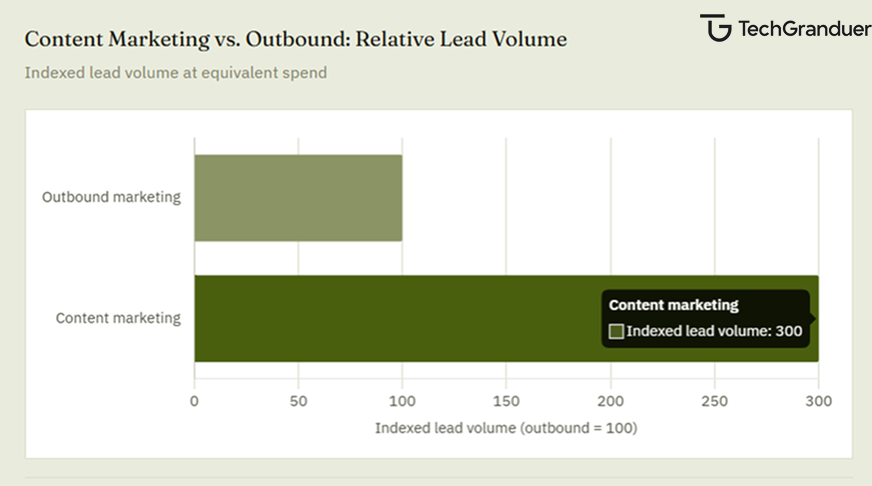
A healthy content plan covers all three. The evidence also argues for treating content as a system rather than a publishing checklist. In CMI’s 2025 B2B benchmark research, 74% of respondents said content marketing helped generate demand or leads, while 49% said it helped generate sales or revenue.
The same research found that only 29% rated their documented content strategy as extremely or very effective, which reinforces the need for clear goals, audience research, measurement, and iteration. Content Marketing Institute’s 2025 B2B research provides the current benchmark context.
The frequently cited “3× as many leads” finding comes from older Demand Metric research, so it should be treated as historical context rather than a current universal benchmark.
KPIs Worth Tracking
- Traffic and visibility: organic sessions, impressions, indexed pages, keyword position distribution.
- Technical health: Core Web Vitals scores, crawl errors, mobile usability issues.
- Business outcomes: qualified leads, demo or consultation bookings, and, critically for a multi-vertical agency, which vertical each conversion came from.
Why Ranking Position Still Decides Most of the Outcome
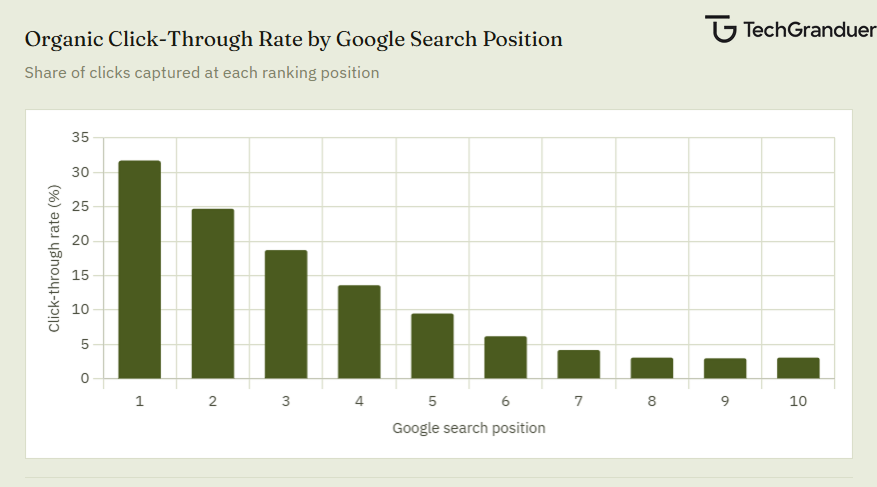
The value of ranking position itself is well documented. Backlinko’s large-scale study of Google search results found the #1 organic position captures roughly a third of all clicks, with a steep drop-off through the top ten and a sharp fall-off past page one.
This is why a realistic content plan prioritizes fewer, stronger pages built to actually reach the top three positions over a larger volume of pages that stall on page two.
Why Consistency Compounds
The gap between B2B marketers who treat content as a system and those who treat it as a series of one-off pieces shows up clearly in benchmark research. Content Marketing Institute’s benchmark surveys consistently find that marketers who attribute their improved results to two specific habits — sharpening content creation quality and revisiting their strategy on a set cadence — outperform those who don’t, regardless of budget size.
The Pillar-and-Cluster Model, Applied
If we take this guide as the pillar. It should sit at the center of a structure like this:
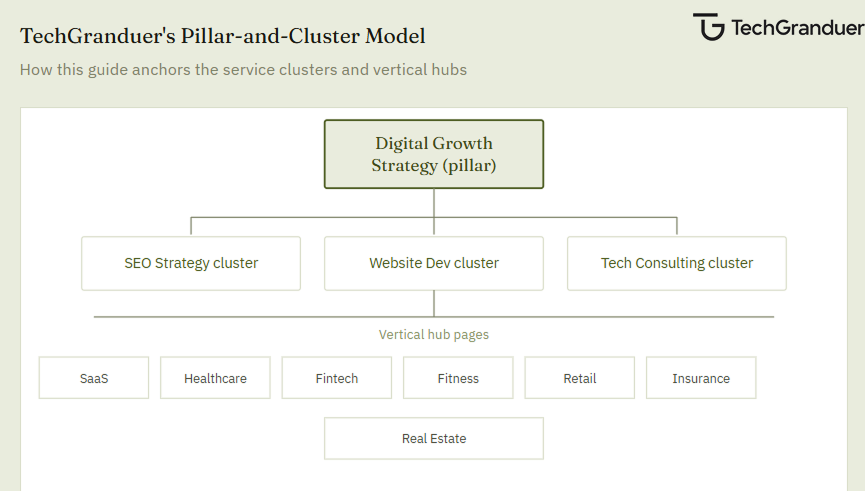
Every cluster piece should link back here; this guide should link out to each relevant cluster page as those pages go live. That structure helps users and search engines discover related pages and understand how the site’s content fits together.
Google’s current Search guidance specifically recommends making important content discoverable through internal links and keeping important information available in text.
Execution
SEO Strategy and Content That Actually Performs
Generic advice content is easy to write and easy to ignore. What differentiates a piece worth ranking and sharing:
- Original data or case studies: even small, real numbers from TechGranduer’s own client work outperform generic claims.
- Frameworks with name: the three-layer audit or the sequencing decision described above are more memorable and more linkable than unstructured advice.
- Expert commentary: quotes or perspectives from TechGranduer’s own consultants add credibility competitors can’t copy.
- Comparison tables: “SEO vs. website rebuild vs. tech consulting: which do you need first” is exactly the kind of asset that gets bookmarked and linked to.
Website Development as a Growth and Search Lever
Page experience is a confirmed part of Google’s ranking systems, even if it’s a lighter-weight signal than content relevance itself.
Google’s own documentation states plainly that sites should aim for good Core Web Vitals. In simple words, it means, Largest Contentful Paint under 2.5 seconds, Interaction to Next Paint under 200 milliseconds, and Cumulative Layout Shift under 0.1 both for ranking purposes and for genuine user experience. Google has also clarified in its updated documentation that beyond these core metrics, other page-experience factors don’t move rankings directly, but they do influence whether visitors stay, convert, and return.
For TechGranduer, this is the technical argument for treating website development as growth infrastructure rather than a one-time design project.
| Core Web Vital | What it measures | Target |
|---|---|---|
| Largest Contentful Paint (LCP) | Loading performance | Under 2.5 seconds |
| Interaction to Next Paint (INP) | Responsiveness | Under 200 milliseconds |
| Cumulative Layout Shift (CLS) | Visual stability | Under 0.1 |
Source: Google Search Central. Thresholds shown are recommended “good” targets, not guarantees of rankings.
Technology Consulting as the Connective Tissue
Content here should focus on the decision points businesses face: when a CMS becomes a liability, when custom integrations are worth the investment, when it’s time to move off a legacy stack. This is naturally decision-stage content — the reader is already convinced they need help; they need to be convinced TechGranduer is the right partner.
Search, AI Overviews, and Distribution
Optimizing for AI search does not require a separate technical markup system. Google’s current guidance says the same SEO fundamentals remain useful for AI features: allow crawling, make important content easy to find through internal links, provide a strong page experience, keep important information in text, and ensure structured data matches the visible page content. For TechGranduer, that means the same well-organized pillar-and-cluster architecture should support both conventional search and AI-powered search experiences.
Promotion and Distribution
For a B2B, multi-vertical agency, the highest-leverage promotion channels are usually narrower and more relationship-based than broad social sharing: LinkedIn, relevant industry newsletters per vertical, guest contributions on partner or complementary agency sites, and direct outreach to past clients and referral partners.
Measuring What Matters
Beyond traffic and rankings, the metric that matters most for a services business is attributed pipeline — which piece of content, for which vertical, led to a booked consultation. Setting this up early, via UTM tracking and CRM attribution, prevents months of guessing whether the content program is working.Part 5
Auditing and Maintenance
Digital growth isn’t a project with an end date. Instead it’s a system that needs revisiting.
Industry benchmark research on B2B content programs consistently finds that the most effective teams are the ones that formally review strategy on a set cadence rather than letting it run unexamined, a pattern documented across successive years of Content Marketing Institute benchmark studies. Every six to twelve months:
- Re-run the SWOT: competitors change, algorithms change, and a strength like early-mover advantage in a niche can erode.
- Audit existing content for pages ranking on page two that could move to page one with updates, rather than only producing new pages.
- Reassess the tech stack: what was sufficient at 20 pages of content may not be sufficient at 100.
- Rebalance investment across the three service lines and across verticals based on which are actually converting.
A useful model: put the majority of resources into what’s proven to work, and keep a smaller portion for experimentation — testing a new vertical hub, a new content format, or an emerging channel like AI and GEO visibility.Conclusion
A System, Not a Service
Digital growth strategy isn’t SEO, or a website, or a piece of technology advice in isolation. It’s the sequencing and interplay between all three. That’s where TechGranduer comes into the game. We combine three independent systems to build a digital growth strategy for your business.
Digital Growth Strategy FAQs
What should a digital growth strategy include?
A practical digital growth strategy should connect business goals, target audiences, search visibility, content, website performance, technology, conversion paths, and measurement. The exact mix depends on the company’s market, maturity, resources, and sales cycle.
How long does a digital growth strategy take to work?
There is no universal timeline. Technical fixes can produce relatively quick improvements, while organic search and content programs usually require sustained publishing, internal linking, authority building, and iteration. Newer sites should generally set expectations around leading indicators before expecting competitive commercial rankings.
Should I do SEO or redesign my website first?
If the website has serious crawlability, performance, mobile, security, or conversion problems, fix the foundation before scaling SEO. If the site is technically sound but lacks search visibility and useful content, SEO and content may deserve priority. If both are healthy, sequence the work around the highest-value business constraint.
What are the most important digital growth KPIs?
Track a mix of visibility, technical health, engagement, conversions, and pipeline. Useful measures include organic impressions, clicks, rankings, indexed pages, Core Web Vitals, qualified leads, consultation or demo bookings, conversion rates, and attributed pipeline.
How often should a digital growth strategy be reviewed?
Review performance continuously through Search Console, analytics, and CRM data, with a deeper strategic review at least every six to twelve months. Revisit priorities sooner when the business enters a new market, launches a new product, changes its technology stack, or sees a material shift in search demand or competitors.
How does content fit into a B2B digital growth strategy?
Content should map to buyer questions across awareness, consideration, and decision stages. Pillar pages provide broad topical coverage, cluster content answers narrower questions, and commercial pages give high-intent visitors a clear path to enquire or buy.
Further Reading
- Google Search Central — Creating Helpful, Reliable, People-First Content
- Google Search Central — AI Features and Your Website
- Google Search Central — Core Web Vitals and Google Search
- Google Search Central — Article Structured Data
- Google Search Central — Breadcrumb Structured Data
- Content Marketing Institute — B2B Content Marketing Benchmarks, Budgets and Trends: Outlook for 2025
- IDC — DX Software in Transition: AI Investment Trends by Sector
- MarketingProfs — Demand Metric Content Marketing Research (historical)