Search Engine Monitoring: What It Is, What to Track, and the Best Tools
Search engine monitoring used to mean checking where your website ranked on Google. Rankings still matter, but they no longer tell the whole story.
Your business can appear in a traditional organic listing, a Google AI Overview, an answer from ChatGPT or Perplexity, or a paid ad triggered by your brand name. Each search surface creates a different visibility opportunity, and each requires its own data.
This guide explains what search engine monitoring covers, which metrics matter, how to build a repeatable monitoring process, and which search engine monitoring tools fit each job.
It also includes TechGranduer’s review of 19 published guides, highlighting gaps in how the industry approaches AI search visibility and branded paid search.
Search engine monitoring is the ongoing process of tracking how your website and brand appear across search results, including organic rankings, AI-generated answers and paid ads on your branded keywords. It combines first-party performance data from platforms such as Google Search Console and Bing Webmaster Tools with third-party rank trackers, AI visibility platforms and paid search monitoring tools. The goal is to identify changes early, understand their business impact and decide what to do next.
What Is Search Engine Monitoring?
Search engine monitoring is a measurement discipline. You are not improving anything yet. You are building a reliable picture of where you stand so the improvements you make later are aimed at the right pages and the right problems.
A good monitoring setup answers four questions on a regular schedule:
- Where do we appear? Rankings, SERP features, and AI answer citations for the queries that matter to the business.
- What changed? Movements up or down, new competitors, new SERP layouts.
- Did it affect results? Impressions, clicks, traffic, and conversions.
- What should we do next? Which page to fix, which keyword to push, which issue to investigate.
Search Engine Monitoring vs. SEO Monitoring vs. Rank Tracking
These terms overlap, and people often use them interchangeably. The practical difference is scope:
| Term | Scope | Typical data |
|---|---|---|
| Rank tracking | Positions for a chosen keyword list | Position, ranking URL, movement, location, device |
| SEO monitoring | Your site’s organic health and performance | Rankings, clicks, CTR, indexation, crawl errors, Core Web Vitals, backlinks |
| Search engine monitoring | Your full presence across search surfaces | All of the above, plus AI answer citations and paid ads on your brand terms |
If you only need positions for a keyword list, rank tracking may be enough. If you need to understand technical health, search traffic, AI citations and branded ad activity, you need a broader monitoring process.
Our B2B SEO services bring technical SEO, content optimization, authority building, and performance measurement together. For the narrower ranking workflow, see our step-by-step guide on how to monitor search engine rankings. This page covers the wider view.
Why Search Engine Monitoring Matters More Now
Two things changed how search visibility turns into traffic.
First, AI summaries now sit above many organic results, and they change how people click. In a Pew Research Center analysis of 68,879 Google searches made by 900 U.S. adults in March 2025, users clicked a traditional result in 8% of visits when an AI summary appeared, compared with 15% when it did not. They clicked a link inside the summary itself in just 1% of visits.
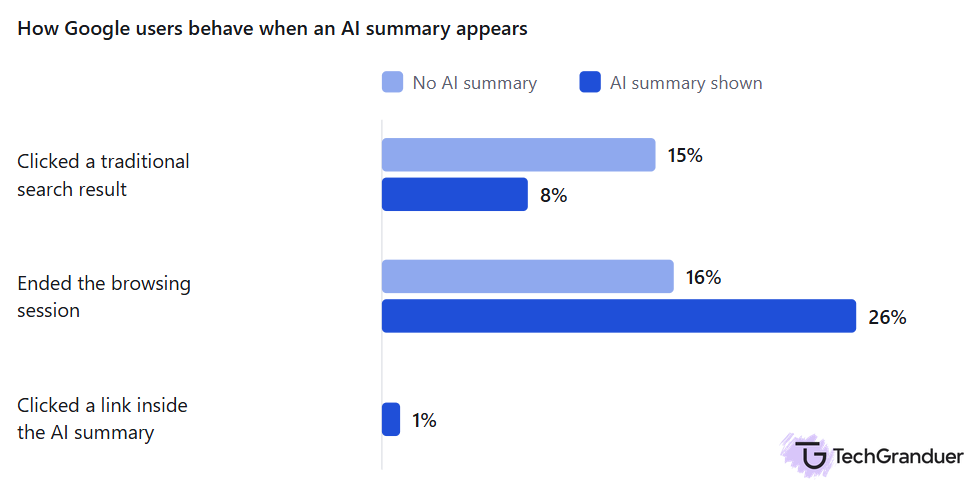
Share of visits to a Google search page, March 2025. Source: Pew Research Center, browsing data from 900 U.S. adults. Chart by TechGranduer.
Second, the number of queries that show an AI Overview is large and it moves around. A Semrush study of more than 10 million keywords found AI Overviews on 6.49% of queries in January 2025, rising to 24.61% in July before settling at 15.69% in November.
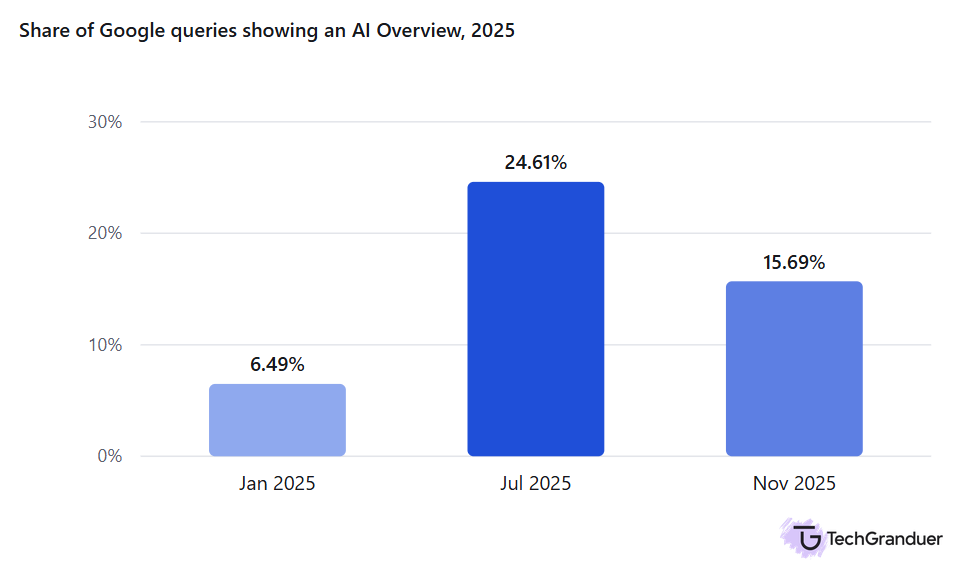
Percentage of tracked keywords that triggered an AI Overview. Source: Semrush AI Overviews Study, 10M+ keywords. Chart by TechGranduer.
Put together, this means a stable ranking no longer guarantees stable traffic. A page can hold position three while its clicks fall because an AI Overview started appearing on that query. You only catch that if you monitor rankings, SERP features, and clicks together.
TechGranduer Research: What Most Search Engine Monitoring Guides Miss
If search now has three surfaces worth watching, the advice people find should reflect that. To check, we reviewed 19 articles that appeared in web search results for “search engine monitoring,” “search engine monitoring tools,” “search engine monitoring software,” and related queries on October 29, 2026. We scored every article against the same four questions.
Key findings
- 58% (11 of 19) did not mention AI search visibility at all. Only 37% (7 of 19) gave it a dedicated section or recommended a tool built for it.
- Just 1 of 19 (5%) mentioned Bing Webmaster Tools, which now reports when your pages are cited in Copilot and Bing’s AI summaries.
- None of the 19 covered monitoring ads that bid on your own brand terms.
- None covered all three types of search engine monitoring.
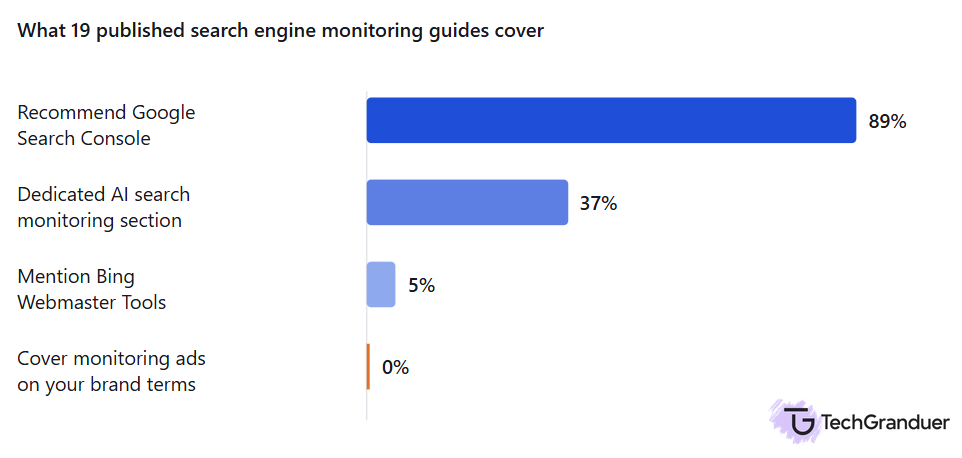
Source: TechGranduer review of 19 articles (18 publishers) found in web search results for search engine monitoring queries, October 29, 2026.
Even recently refreshed content has not caught up: of the 9 articles updated since July 2026, 7 still say nothing about AI search. The full methodology, a breakdown by article type, and the complete dataset are in our research report, The AI Blind Spot: What 19 Search Engine Monitoring Guides Miss.
The gap matters because the risks those guides skip are the ones that move fastest. AI Overviews can change your click-through rate without any change in rank, and branded ad hijacking can drain high-intent traffic you already earned. The rest of this guide covers all three types.
The Three Types of Search Engine Monitoring
| Type | What it watches | Main question it answers |
|---|---|---|
| Organic rank and visibility monitoring | Positions, SERP features, impressions, clicks | Are our pages visible and earning clicks? |
| AI search monitoring | Brand mentions and citations in AI answers | Do AI systems recommend or cite us? |
| Paid search brand monitoring | Ads bidding on your brand terms | Is anyone hijacking our branded traffic? |
1. Organic Rank and Visibility Monitoring
This is the foundation. You track positions for a defined keyword list, by location and device, and connect them to impressions, clicks, and conversions.
Position matters because clicks are not spread evenly. In a Backlinko analysis of 4 million Google results, the top result averaged a 27.6% click-through rate. The same study found that the value of moving up one spot depends heavily on where you start.
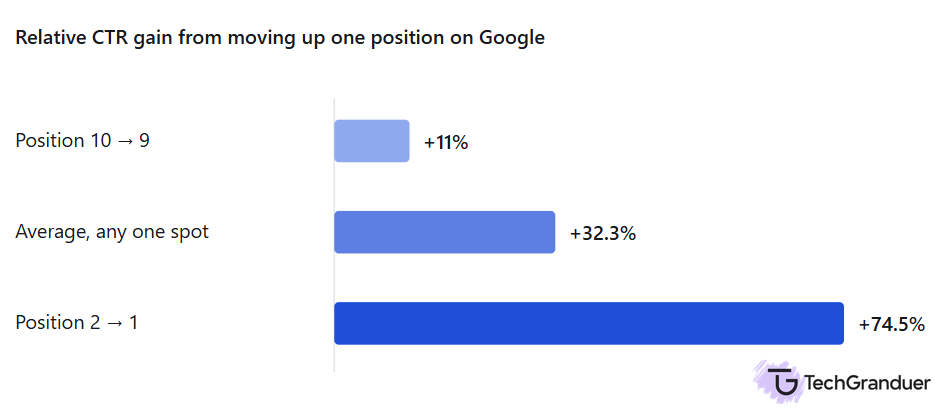
Relative increase in click-through rate. Source: Backlinko organic CTR study, ~4 million Google search results. Chart by TechGranduer.
This is why monitoring should flag pages near the top of page one, not only pages that drop. A page sitting at position two is often the highest-value optimization target on a site. For the detailed workflow, including keyword selection and what to do when rankings drop, see our rank monitoring guide.
2. AI Search Monitoring
AI search monitoring tracks whether AI systems such as Google’s AI Overviews, ChatGPT, Perplexity, and Microsoft Copilot mention your brand or cite your pages when people ask questions in your category.
The data here is still thin. Google Search Console does not separate AI Overview performance from regular results. Microsoft has gone further: since February 2026, the AI Performance report in Bing Webmaster Tools shows when your site is cited in Copilot and in AI-generated summaries in Bing. Yet in our review, only one of 19 search engine monitoring guides mentioned Bing Webmaster Tools at all. For other AI platforms, you need a dedicated AI visibility tracker that runs a fixed set of prompts on a schedule and records which brands and URLs appear.
What to track in AI search:
- Mentions: how often your brand is named in answers to category prompts.
- Citations: which of your URLs are linked as sources.
- Share of voice: your mentions compared with named competitors.
- Accuracy: whether the answers describe your product, pricing, and positioning correctly.
Monitoring tells you where you stand; improving those results requires a separate optimization process. Our guide to LLM SEO explains how content, technical accessibility and authority affect visibility in AI-powered discovery. TechGranduer’s GEO and AEO services include AI visibility audits, content structuring, entity and authority work, and ongoing citation monitoring. For a broader organic growth program that connects technical fixes, content and authority to qualified pipeline, see our SEO Growth program.
3. Paid Search Brand Monitoring
Paid search brand monitoring watches the ads that appear when people search your brand name. Competitors, resellers, or affiliates sometimes bid on your trademark terms, which can raise your own cost per click and divert customers who were already looking for you.
Specialist platforms handle this. BrandVerity, for example, focuses on detecting trademark infringement in search ads and checking affiliate compliance. This type of monitoring matters most for brands with strong branded search demand, affiliate programs, or regulated offers. It is also the most overlooked: none of the 19 guides in our review covered it.
Which Search Engines Should You Monitor?
Google dominates, so it gets most of your monitoring time. But the picture changes by market, and that should shape your setup.
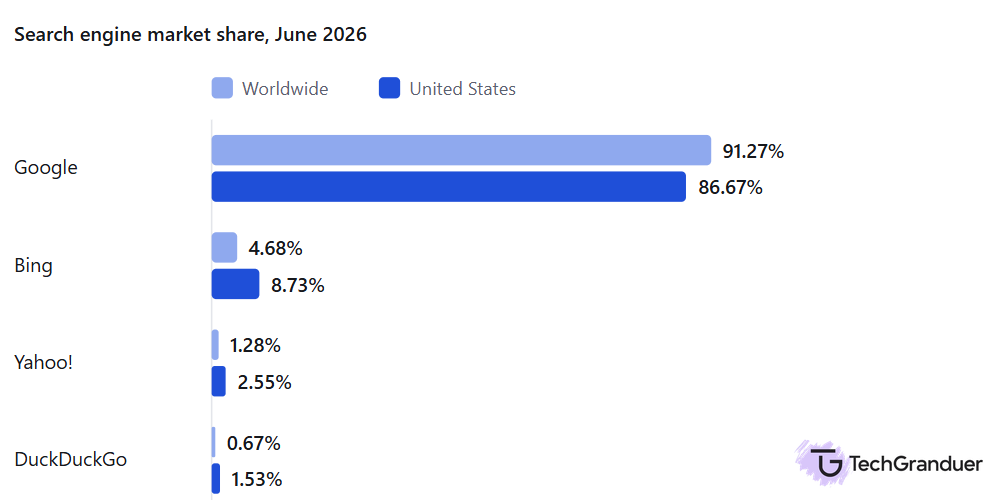
Share of search engine referrals, all platforms. Source: StatCounter Global Stats (worldwide and United States). Chart by TechGranduer.
In the United States, Bing’s share is nearly double its worldwide share in this dataset. For U.S.-focused B2B brands, that is a reason to verify your site in Bing Webmaster Tools and include Bing in your rank tracking, particularly because its AI Performance report adds Copilot citation data. The exact search-engine mix will vary by audience, device and industry, so use your own analytics and customer research to decide how much monitoring effort each platform deserves.
What to Monitor: The Core Metrics
| Metric | What it tells you | Where to get it |
|---|---|---|
| Keyword position | Where a page ranks for a tracked query | Rank tracker; Search Console (average position) |
| Impressions | How often you appeared in results | Google Search Console, Bing Webmaster Tools |
| Clicks and CTR | Whether visibility turns into visits | Google Search Console, Bing Webmaster Tools |
| SERP features | Whether AI Overviews, snippets, or People Also Ask appear for your queries | Rank tracker |
| AI mentions and citations | Whether AI answers name or link to you | AI visibility tracker; Bing AI Performance report |
| Indexation and crawl errors | Whether key pages can appear at all | Search Console Page Indexing report |
| Core Web Vitals | Loading, responsiveness, and visual stability | Search Console; Google’s Web Vitals guidance |
| Organic conversions | Whether search traffic produces leads or revenue | Google Analytics 4 or your analytics platform |
| Branded ad activity | Who bids on your brand terms | Paid search monitoring tool |
Google’s Search Console Performance report documentation explains how clicks, impressions, CTR and average position are calculated. Read it before comparing Search Console data with a third-party rank tracker: average position is an aggregate metric, not a guaranteed position for every user. If the data shows technical problems with crawling, indexation or site structure, TechGranduer’s SEO services include technical SEO audits and prioritized fixes.
How to Set Up Search Engine Monitoring
- Connect first-party data. Verify your site in Google Search Console and Bing Webmaster Tools, and confirm organic traffic and conversions are tracked in your analytics platform. If monitoring exposes persistent site architecture, performance or crawlability problems that require a rebuild, review our website development solution, which includes an SEO foundation from the start.
- Build a keyword list by intent. Include commercial terms tied to your services, informational terms that support them, branded terms, and location-specific terms for each market you sell into.
- Map each keyword to one page. One target page per keyword makes ranking changes easy to read and prevents your own pages from competing with each other.
- Set up rank tracking. Track by country, city where relevant, and device. Turn on SERP feature tracking so you can see when AI Overviews appear on your terms.
- Add an AI prompt set. Write 20 to 50 prompts a buyer might ask in your category, run them on a schedule, and record mentions, citations, and competitors.
- Define alerts and owners. Decide what counts as a significant drop, who gets notified, and who investigates.
How Often Should You Monitor?
| Cadence | What to review |
|---|---|
| Daily | Priority commercial keywords, site migrations, major releases, branded ad activity |
| Weekly | Full keyword list, CTR changes, SERP feature changes, AI prompt results |
| Monthly | Trends in traffic and conversions, competitor movement, share of voice in AI answers |
| Quarterly | Keyword list and prompt set refresh, strategy and content priorities |
Look for trends rather than reacting to every single-day movement. Rankings fluctuate naturally, and decisions made on one day of data are usually wrong.
Search Engine Monitoring Tools by Category
No single tool covers all three types well. Most teams combine a few:
| Category | Examples | Best for |
|---|---|---|
| Free first-party tools | Google Search Console, Bing Webmaster Tools, Google Analytics 4 | Real clicks, impressions, indexation, and Copilot citations |
| All-in-one SEO platforms | Semrush, Ahrefs | Rank tracking plus keyword, competitor, and backlink research, with AI visibility add-ons |
| Dedicated rank trackers | SE Ranking and similar tools | Large keyword lists, local tracking, client reporting |
| AI visibility trackers | Otterly.AI, Profound, Peec AI | Brand mentions, citations, and share of voice across AI platforms |
| Paid search brand monitoring | BrandVerity, The Search Monitor, Adthena | Trademark bidding and affiliate compliance |
When comparing search engine monitoring software, check update frequency, U.S. location coverage, device segmentation, SERP feature and AI Overview tracking, competitor limits, alert options, integrations and how pricing scales with keyword or prompt volume. A tool that tracks thousands of keywords is not automatically the right choice if your team only needs to monitor a focused set of commercial terms. For a wider comparison of platforms used by B2B teams, see our roundup of B2B SEO tools. If you need a content program that turns monitoring insights into a consistent publishing and refresh process, explore our content marketing services.
Turning Monitoring Data Into Action
Monitoring only pays off when each signal leads to a decision. These are the patterns we see most often:
| What you see | Likely cause | What to do |
|---|---|---|
| Position stable, clicks falling | A new AI Overview or SERP feature on the query | Check the live SERP, strengthen the page’s direct answers, and target the AI citation |
| Impressions up, CTR down | Ranking for broader or less relevant queries | Review query mix and rewrite the title and meta description for the core intent |
| Page stuck at positions 4–10 | Content or authority gap versus the top results | Compare against top pages, add depth and internal links, earn relevant links |
| Sudden drop across many pages | Technical issue or algorithm update | Check indexation, crawl errors, and recent site changes before editing content |
| Competitors cited in AI answers, you are not | Weaker topical coverage or third-party mentions | Fill content gaps and build mentions on sources AI systems cite |
| Ads appearing on your brand name | Trademark bidding by a competitor or affiliate | Document the ads and use the search engine’s trademark complaint process |
Monitoring also feeds bigger decisions. If you are reviewing whether your current approach is working, our guide to evaluating an SEO strategy shows how to use performance data to assess priorities, execution and commercial outcomes. For teams that need to connect organic visibility to qualified inquiries, the B2B lead generation solution brings buyer-intent research, content, landing pages and conversion optimization into one program.
Frequently Asked Questions
What is search engine monitoring?
Search engine monitoring is the ongoing tracking of how your website and brand appear in search, including organic rankings, AI-generated answers, and paid ads on your brand terms. It shows what changed and helps you decide what to fix next.
Is search engine monitoring the same as SEO monitoring?
Not quite. SEO monitoring focuses on your site’s organic performance and technical health. Search engine monitoring is broader and also covers AI answer visibility and paid ads that target your brand.
Can I monitor search engines for free?
Yes, partly. Google Search Console and Bing Webmaster Tools are free and provide real clicks, impressions, average position, and indexation data. Bing’s AI Performance report also shows Copilot citations. Tracking exact positions by location, AI answers on other platforms, and branded ads usually requires paid tools.
How do I monitor my brand in ChatGPT and other AI tools?
Create a fixed list of prompts your buyers would ask, run them on a regular schedule, and record whether your brand is mentioned or cited and which competitors appear. AI visibility trackers automate this across several platforms.
How often should I check my search visibility?
Weekly is enough for most sites. Check priority commercial keywords daily during launches, migrations, or major updates, and review trends monthly to guide strategy.
What is search engine monitoring software?
Search engine monitoring software helps teams track website visibility and changes across search results. Depending on the platform, it may include keyword rank tracking, competitor monitoring, SERP feature tracking, technical alerts, AI mentions and citations, or branded paid search monitoring. Most businesses use more than one tool because no single platform covers every search surface equally well.
What is BrandVerity used for?
BrandVerity is a brand protection platform used mainly for paid search monitoring. It detects ads that bid on or misuse your trademark and helps brands enforce affiliate and search engine ad policies.
Want Search Monitoring That Leads to Growth?
TechGranduer helps B2B and technology companies monitor organic search performance and AI visibility, identify what is limiting discovery, and turn the findings into a prioritized growth plan. Explore our B2B SEO services, GEO and AEO services, or SEO Growth program. If your priority is turning relevant search traffic into qualified opportunities, see our B2B lead generation solution or contact our team.