How to Build an SEO Team: A Complete Guide for B2B Companies

This guide is for founders, CMOs, and marketing leaders at B2B companies who want to build SEO in-house, or who already have one SEO person and want to turn that into a team that produces pipeline.
By the end, you’ll know what an SEO team does, which roles to hire and in what order, how to structure the team, which tools it needs, and how to measure whether it’s working.
The short answer: hire an SEO lead first, someone who can set strategy and win developer time. Then add roles one at a time based on your biggest bottleneck, usually a writer, then an editor and GEO specialist, then technical, analytics, and digital PR support. Start with a centralized team that reports into marketing, give it guaranteed developer capacity, and judge it on qualified leads and pipeline rather than rankings alone.
The rest of this guide explains each part of that answer, with the reasoning behind it, so you can adapt it to your own company.
Key takeaways
- An SEO team earns qualified visibility in search engines and AI answers, then turns that visibility into pipeline.
- Five responsibilities need a clear owner: strategy, content, technical SEO, authority, and measurement.
- Hire the SEO lead or strategist first. Every other role executes the decisions they make.
- Add roles based on your current bottleneck, not on an org chart template.
- Small teams work best centralized. Larger companies usually move to a hub-and-spoke structure.
- SEO needs guaranteed developer time. Without it, technical recommendations sit in a backlog.
- Judge the team on qualified leads and pipeline, with rankings and traffic as leading indicators.
In this guide
- What is an SEO team?
- What does an SEO team do?
- Do you need an in-house SEO team?
- The core roles on an in-house SEO team
- How to build an SEO team, step by step
- Hiring your first SEO lead
- SEO department structure
- The tools your SEO team needs
- How to measure an SEO team
- Common mistakes to avoid
- Frequently asked questions
1. What Is an SEO Team?
An SEO team is the group of people responsible for making your website visible in search, both in Google’s results and increasingly in AI-generated answers from tools like ChatGPT, Perplexity, and Google’s AI Overviews, and for making sure that visibility turns into business.
On paper, that sounds like a marketing function. In practice, it cuts across marketing, engineering, product, and sales. An SEO team decides what content gets created, asks developers to change how pages are built, and needs CRM data to prove any of it worked.
That’s why “SEO team” can describe anything from one person working with a freelance writer to a twenty-person department. The size varies a lot. The responsibilities don’t.
2. What Does an SEO Team Do?
Whatever its size, an SEO team does five jobs.
- Decides what to target. Keyword research, search intent analysis, and choosing which pages to create, update, or merge, prioritized by commercial value rather than search volume alone.
- Creates and improves content. New pages that answer buyer questions properly, plus regular refreshes of pages that are slipping.
- Keeps the site technically healthy. Crawlability, indexation, site architecture, internal linking, page speed, and structured data.
- Builds authority. Earning links and brand mentions from relevant sites, which also influences which brands AI systems mention and cite.
- Measures what worked. Connecting Search Console, analytics, and CRM data to show which pages produce leads and revenue.
Around those five jobs sits a lot of coordination. Briefs go to writers, tickets go to developers, and questions come back from sales.
That last loop is underrated. Imagine an HR software company whose sales team keeps hearing the same question on calls: “Does it integrate with our payroll system?” A good SEO team turns that into a set of integration pages, because if prospects ask it on calls, they’re also typing it into Google and ChatGPT.
3. Do You Need an In-House SEO Team?
Not every company needs one yet. Before you hire, it’s worth checking whether SEO is genuinely a channel you plan to invest in for years, because an in-house team takes time to pay back. If you’re unsure whether SEO suits your business at all, our article on whether SEO works for B2B companies is a good place to start.
Building in-house usually makes sense when several of these are true:
- Organic search is, or should be, one of your top two or three sources of qualified leads.
- Your product is technical enough that outside writers struggle without constant access to your experts.
- You have a large or complex website, such as documentation, integrations, or several product lines.
- You can commit budget for at least a year, not a quarter.
- You have developers who can give SEO regular time.
If only one or two apply, a hybrid setup is usually smarter: one in-house SEO owner supported by an agency or specialist freelancers. You keep control of strategy without carrying the cost of a full team.
4. The Core Roles on an In-House SEO Team
You don’t need all of these people on day one. You do need to know who covers each responsibility, even if one person covers several for now.
| Role | What they own | When to add them |
|---|---|---|
| SEO lead or strategist | Strategy, keyword priorities, roadmap, alignment with sales and product | First hire |
| Technical SEO specialist | Crawling, indexation, site architecture, structured data, developer tickets | When the site is large or JavaScript-heavy, or technical tickets keep piling up |
| Content strategist or SME writer | Briefs, expert content, refreshes | When the strategist has more priority topics than the team can publish |
| Editor | Accuracy, voice, consistency, compliance checks | When you publish several pieces a month or work in a regulated industry |
| GEO and AEO specialist | Visibility and citations in AI answers, prompt tracking | When your buyers research vendors in AI tools, which in B2B is most of them |
| Digital PR and authority specialist | Links, brand mentions, research assets | When content quality is strong but rankings stall on competitive terms |
| SEO analyst | Dashboards, attribution, Search Console, analytics, and CRM data | When leadership asks what SEO generated and nobody can answer quickly |
The responsibilities are the same whether the people sit in-house or at an agency. For a deeper look at each role, and at how agency teams compare, see our guide to SEO agency team structure.
5. How to Build an SEO Team, Step by Step
Step 1: Define what the team is for
“More traffic” isn’t a goal. Decide which business result the team exists to produce, such as demo requests, trial sign-ups, or pipeline from organic search, and how you’ll measure it. That decision shapes every hire that follows.
Step 2: Audit the skills you already have
Many companies already own half an SEO team without realizing it. You may have content writers in marketing, developers with spare sprint capacity, and someone in RevOps who knows the CRM well. List those people first, then look at what’s genuinely missing.
Step 3: Hire the SEO lead first
Your first hire should be the person who decides what the team works on. The most common mistake I see is hiring a junior executor first because they’re cheaper. Without a strategist, they end up producing busy work: lots of activity, aimed at the wrong keywords. Section 6 covers what to look for in this hire.
Step 4: Fill gaps based on the bottleneck
After two or three months, ask your SEO lead one question: what’s slowing us down most? The answer tells you the next hire.
- Not enough publishing capacity? Add a writer or content strategist.
- Technical fixes stuck in the backlog? Secure developer time or a technical specialist.
- Content is good but you can’t prove ROI? Add an analyst.
- Strong content that won’t move on competitive keywords? Invest in authority building.
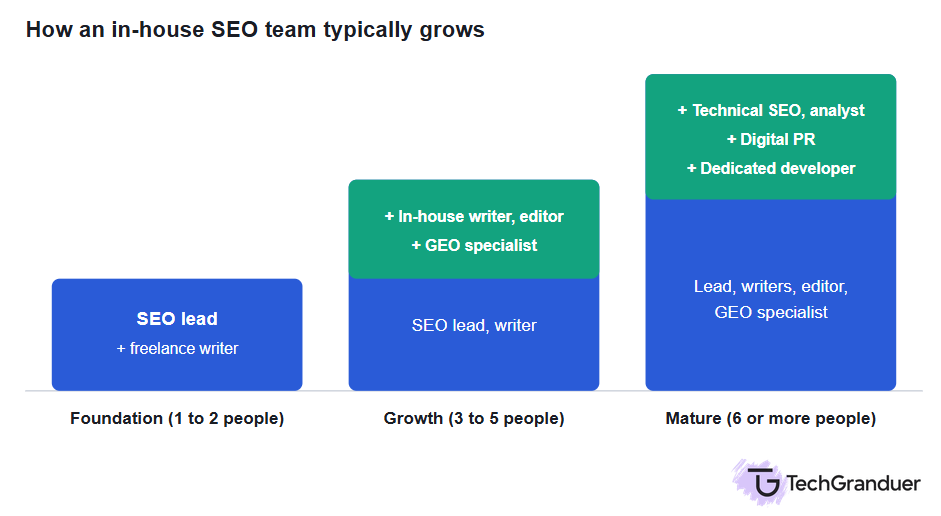
A typical hiring sequence. Green shows the roles added at each stage. Your order may differ depending on your bottleneck.
Step 5: Agree on how SEO works with other teams
Most SEO teams fail at the edges, not in the middle. Before the team grows, agree on four things: how much developer sprint capacity SEO gets, how content briefs move from strategist to writer, how sales feedback reaches the SEO lead, and who signs off on technical or regulated claims.
Step 6: Decide what to outsource
Some work is needed only occasionally or requires deep specialization, such as technical audits, site migrations, digital PR campaigns, or a burst of content production. It’s often cheaper to bring in outside help for these than to hire full time. Many B2B companies keep strategy in-house and use an agency for execution. If you go that route, our framework for evaluating an SEO strategy will help you judge what a provider proposes.
Step 7: Review the structure every quarter
The right team for this year won’t be the right team in two years. Review the team when your goals, product lines, or markets change, and adjust roles before gaps start to show in the results.
6. Hiring Your First SEO Lead
Your first SEO hire shapes everything that follows, so it deserves more care than any other role on the team.
What to look for
- Commercial judgment. They should talk about which searches lead to customers, not just which keywords have volume.
- Search intent skills. They can look at a results page and explain what type of page deserves to rank and why.
- Influence without authority. They’ll need developers, product managers, and writers to prioritize their requests. Ask for examples of how they’ve done that.
- Comfort with data. They should be able to connect Search Console and analytics data to leads, or at least explain how they would.
- Awareness of AI search. They should have a view on how brands get cited in AI answers and how to track it.
Questions worth asking in the interview
- Walk me through how you’d decide what our first ten pages should target.
- Tell me about a technical fix you needed developers to ship. How did you get it prioritized?
- How would you report on SEO to our leadership team after six months?
- How would you find out whether AI assistants mention us when buyers ask about our category?
What their first 90 days should look like
- Days 1 to 30: audit the site, current rankings, and analytics setup. Interview sales and product. Fix measurement gaps.
- Days 31 to 60: build the keyword and content roadmap, prioritized by commercial value. Ship the most urgent technical fixes.
- Days 61 to 90: publish or refresh the first priority pages, set up reporting, and recommend the next hire based on the biggest bottleneck.
7. SEO Department Structure: Where the Team Sits and How It’s Organized
Who should SEO report to?
In most B2B companies, SEO reports into marketing, usually under demand generation. That makes sense, because SEO’s job is to produce pipeline. The risk is distance from engineering, since marketing rarely controls developer time.
Product-led companies sometimes place SEO under growth or product instead, which makes technical work easier but can weaken the link to sales. My preference for most B2B companies is a marketing reporting line combined with a formal, agreed developer allocation.
The four common structures
| Structure | How it works | Works best for | Watch out for |
|---|---|---|---|
| Centralized | One SEO team handles all SEO for the company | Startups and mid-sized companies with one main product | Becomes a bottleneck as product lines grow |
| Embedded | SEO specialists sit inside product or regional teams | Companies with very different product lines or markets | Inconsistent standards and duplicated effort |
| Hub-and-spoke | A central SEO team sets strategy and standards, with specialists or trained owners in each team | Larger B2B and enterprise companies | Needs strong documentation and a clear owner at the hub |
| Pod | Small cross-functional groups (strategist, writer, developer) own a product area or goal | Fast-moving growth teams | Gaps in any pod affect everything that pod owns |
If you’re building your first team, start centralized. It’s simpler to manage and easier to hold accountable. Move toward a hub-and-spoke once you have several product lines or markets that need their own SEO attention.
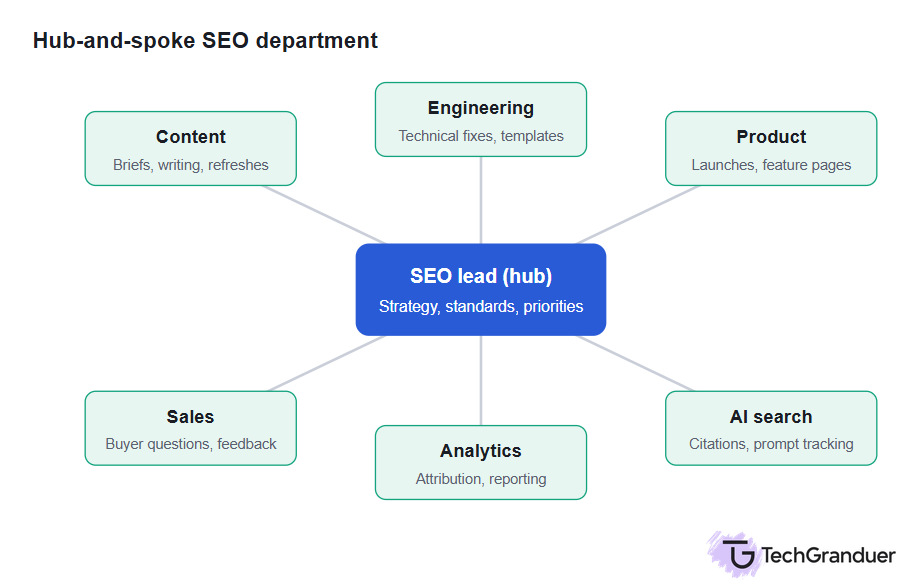
In a hub-and-spoke structure, the SEO lead sets priorities and standards while specialists or trained owners in each team carry out the work.
8. The Tools Your SEO Team Needs
Tools don’t replace people, but the wrong stack slows a good team down. A common mistake is buying enterprise platforms before anyone has the time to use them. I’d build the stack by category and add tools only when someone on the team will use them every week.
- Free foundations: Google Search Console and Google Analytics 4. Every team needs these from day one, and they’re often underused.
- Keyword and competitor research: an all-in-one platform such as Ahrefs or Semrush covers keyword research, competitor analysis, and backlink data.
- Technical auditing: a crawler such as Screaming Frog to find broken links, redirect chains, indexation issues, and missing metadata.
- Rank and AI visibility tracking: tools that monitor priority keyword positions and how often your brand appears or is cited in AI answers.
- Content optimization: tools that help writers cover a topic thoroughly and match search intent.
- Reporting: a dashboard tool such as Looker Studio to bring search, analytics, and CRM data together for leadership.
A one-person team can do good work with Search Console, Analytics, one research platform, and a crawler. Add tracking, content, and reporting tools as the team and its reporting needs grow.
9. How to Measure an SEO Team
I’d measure any SEO team on two layers.
- Leading indicators tell you whether the work is on track: impressions and rankings for priority keywords, the number of pages indexed, and how often your brand is mentioned or cited in AI answers. Our guide to search engine monitoring covers what to track and which tools help, and this walkthrough on how to monitor search engine rankings covers the day-to-day side.
- Business outcomes tell you whether the work matters: organic conversions, qualified leads, pipeline influenced by organic search, and customer acquisition cost. For realistic targets, see our B2B SaaS conversion rate benchmarks.
Set expectations early. Google’s own guidance on hiring an SEO notes that improvements often take several months to show their benefit, so review leading indicators monthly and business outcomes quarterly.
10. Common Mistakes When Building an SEO Team
- Expecting one generalist to be a department. One person can lead SEO. They can’t also write, code, and build every report.
- Letting writers choose keywords. Keyword selection is a commercial decision and belongs with the strategist.
- Giving SEO no developer time. Technical recommendations that never ship don’t help anyone.
- Measuring only rankings. A team rewarded for rankings will chase keywords that rank, not keywords that sell.
- Ignoring AI search. If nobody owns how your brand appears in AI answers, you may miss shortlists you never knew existed.
- Buying tools before people. An expensive platform with nobody to use it is wasted budget.
- Hiring before setting goals. Without a clear target, you can’t tell which role you need next.
Building the Right Team for Your Stage
A great SEO team isn’t defined by headcount. It’s defined by whether strategy, content, technical SEO, authority, and measurement each have a capable owner, and whether the team has the access it needs to developers, product, and sales.
Start with a strong lead, add roles as bottlenecks appear, and keep the structure simple until growth forces it to change.
If you’re building an in-house team and need to cover gaps in the meantime, TechGranduer works alongside internal teams on B2B SEO, GEO and AEO, content, and web development. Tell us what you’re building, and we’ll help you work out which roles to hire and which to outsource.
Frequently Asked Questions
How many people should be on an SEO team?
It depends on your stage and goals. An early-stage company can start with one SEO lead and a freelance writer. A growth-stage B2B company usually needs three to five people, and larger companies with several product lines often need six or more. Clear ownership of each responsibility matters more than the headcount.
Who should be the first SEO hire?
An SEO lead or strategist. This person decides which keywords and topics the team pursues and builds the roadmap. Writers, developers, and analysts are far more effective once that direction exists.
Who should an SEO team report to?
In most B2B companies, SEO reports into marketing, often under demand generation, because its job is to generate pipeline. Whichever reporting line you choose, make sure the team has agreed access to developer time.
Can one person be an SEO team?
One person can lead SEO and cover strategy, but they can’t do everything well at scale. Most single-person setups work only with outside support for content, development, or technical work.
Should an in-house SEO team include a GEO or AI search specialist?
For most B2B companies, yes. Buyers increasingly use AI assistants to research vendors and build shortlists. Someone on the team should own how your brand appears in those answers, even if that’s initially part of the SEO lead’s role.