SEO Agency Team Structure: Roles, Models, and What B2B Companies Should Expect
When B2B companies evaluate an SEO agency, they usually ask about price, timelines, and case studies. Very few ask who will actually be doing the work.
I think that’s a mistake.
The people assigned to your account, and how their responsibilities are divided, tell you more about how an agency approaches SEO than any sales deck. An agency that puts mostly link builders on a campaign believes rankings come from links. An agency that puts mostly writers on it believes rankings come from content. An agency that hands everything to one generalist probably hasn’t thought about it very much.
None of these approaches is automatically wrong. But the structure should match what your business actually needs.
In this article, I’ll walk through every role you’d expect to find on a well-built SEO team in 2026, including the newer roles that AI search has made necessary. Then I’ll compare the most common agency models, explain how team structure should change depending on your company’s stage, and share the questions I’d ask before signing with any provider.
Whether you’re vetting B2B SEO services or planning to build an in-house team, this should give you a clear picture of what “good” looks like.
1. Why SEO Team Structure Matters
SEO isn’t one skill. It’s several different disciplines that need to work together.
Choosing the right keywords is a strategic and commercial skill. Writing a page that genuinely answers a technical buyer’s question is a subject-matter skill. Making sure search engines can crawl and render that page is an engineering skill. Proving the page generated pipeline is an analytics skill.
It’s rare for one person to be excellent at all four.
So when an agency combines roles to keep costs down, something usually gets less attention. Most often, it’s the work that’s hardest for a client to see: keyword prioritization, search intent analysis, and attribution.
Here’s a simple example.
Imagine a cybersecurity SaaS company hires an agency where one account manager also does keyword research and briefs freelance writers. The articles get published on schedule and traffic slowly rises. But six months later, the sales team says organic leads are mostly students and job seekers.
Nothing was “broken.” The work was just never structured around commercial intent, because nobody on the team owned that decision.
That’s why I’d look at team structure as a reflection of an agency’s priorities, not an operational detail.
2. The Roles on a Modern B2B SEO Team
Job titles vary from agency to agency, and smaller teams may have one person covering two roles. What matters is that each responsibility below has a clear owner.
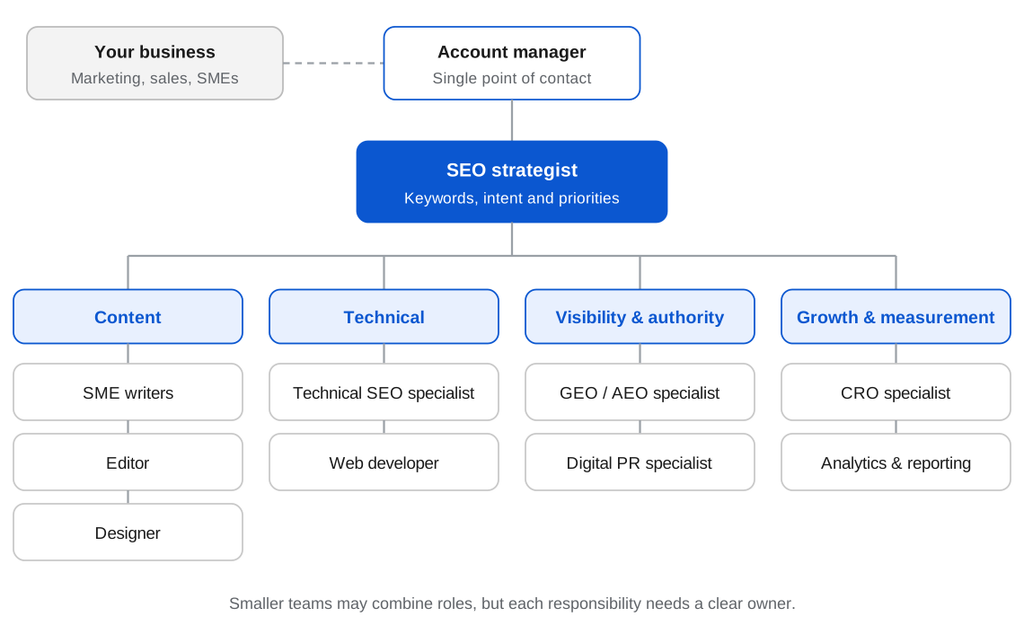
Figure 1: How responsibilities are typically organized on a modern B2B SEO team.
SEO strategist
The strategist decides what the campaign is going to do and why.
They research keywords, analyze search intent, map topics to the buyer journey, and decide which pages should be created, updated, or consolidated. They also decide what type of page each keyword deserves. A query like “SOC 2 compliance checklist” needs a very different page from “SOC 2 compliance software for startups.”
A good strategist understands two things particularly well:
- Commercial value: which searches are likely to come from people who could become customers.
- Search intent: what the person searching actually wants to find, and how the page should be structured to give it to them.
If you only take one thing from this article, let it be this: the strategist is the role I’d least want to see combined with anything else. Every other role on the team executes the decisions this person makes.
Technical SEO specialist
The technical specialist makes sure search engines and AI crawlers can access, render, and understand the website.
That includes crawlability, indexation, site architecture, internal linking, page speed, Core Web Vitals, structured data, canonicalization, redirects, and JavaScript rendering issues. On large B2B sites with documentation hubs, integrations directories, or multiple product lines, this work can be substantial.
This role often works closely with developers. The specialist identifies the problem and specifies the fix. The developer implements it.
Subject matter expert (SME) writer
In B2B, generic content rarely works.
A buyer researching Kubernetes cost optimization or PCI DSS requirements will notice very quickly if the writer doesn’t understand the subject. So will the systems search engines use to evaluate whether content is helpful, reliable, and people-first.
SME writers either come from the industry they write about or have built genuine expertise in it. They produce in-depth content that answers the searcher’s question properly, using the brief the strategist provides.
One thing I’d point out: writers generally shouldn’t choose their own keywords. That can feel counterintuitive, since writers often have good instincts about topics. But keyword selection is a commercial decision, and it belongs with the person who can see the whole campaign.
Editor
The editor makes sure every piece is accurate, clear, on-brand, and written for the right reader.
That covers grammar and style, but also tone, reading level, structure, and keyword placement in titles and headings. In regulated or technical industries like fintech and healthcare, editors also check claims and make sure content stays within compliance guidelines.
Agencies that skip editing tend to produce content that’s technically fine but inconsistent. Over dozens of articles, that inconsistency becomes noticeable.
GEO and AEO specialist
This role barely existed a few years ago. Now I’d consider it essential for most B2B teams.
B2B buyers increasingly use ChatGPT, Perplexity, Gemini, and Google’s AI-generated answers to research problems and build vendor shortlists. If your brand isn’t being mentioned or cited in those answers, you may not make the shortlist at all.
A GEO (generative engine optimization) or AEO (answer engine optimization) specialist focuses on that visibility. They analyze how AI systems answer the questions your buyers ask, which sources those systems cite, and what would make your content easier to extract and reference. They also track brand mentions and AI referral traffic.
In smaller teams, the strategist may take on this responsibility. That can work, as long as someone is explicitly accountable for it. If you’d like to understand how this fits into a broader program, our page on GEO and AEO services goes into more detail.
Digital PR and authority specialist
Links and brand mentions from relevant, reputable websites still help search engines understand which companies are trustworthy in a given space. They also influence which brands AI systems are likely to mention.
The authority specialist earns those mentions through digital PR, original research, expert commentary, partnerships, and outreach. In B2B, this works best when it’s built around genuinely useful assets, such as industry benchmarks or data studies, rather than volume-based link buying.
I’d be cautious about any agency where this role mainly involves purchasing links. That approach carries risk and rarely builds lasting authority.
Conversion rate optimization (CRO) specialist
Traffic only matters if the right visitors take the next step.
The CRO specialist studies how organic visitors move through the website, where they drop off, and which pages lead to demo requests, trial sign-ups, or contact forms. They recommend changes to page layout, calls to action, internal links, and forms.
For B2B SaaS in particular, this role connects SEO to revenue. If you’re curious about realistic targets, our breakdown of B2B SaaS conversion rate benchmarks is a useful starting point.
Designer
Designers create custom diagrams, comparison tables, charts, and illustrations that make complex content easier to understand.
That matters more in B2B than people expect. A clear architecture diagram or workflow graphic can explain in seconds what would take three paragraphs. It also makes the page look like it was built by a company that knows its subject, rather than one that relied on stock photos.
Web developer
The developer implements technical fixes, builds new page templates, improves site speed, and sets up the tracking needed to measure performance.
Some agencies don’t have developers and rely on the client’s internal team. That can work, but it often slows things down. Technical recommendations that sit in a backlog for months don’t help anyone. Having web development capacity on or close to the SEO team usually means fixes ship faster.
Analytics and reporting specialist
This person defines what the campaign will measure and builds the reporting that shows whether it’s working.
That means connecting data from Google Search Console, Google Analytics, rank tracking tools, AI visibility tools, and the CRM into one view. The best reporting doesn’t stop at rankings and sessions. It shows which pages generate qualified leads, which leads became opportunities, and how much pipeline organic search influenced.
If your agency can’t tell you which content contributed to pipeline, I’d treat that as a gap in the team.
Account or campaign manager
The account manager keeps everything moving.
They run meetings, share agendas and summaries, track deliverables, manage approvals, and act as your single point of contact. On B2B accounts, they also coordinate with your product, sales, and compliance teams, which can make a big difference to how quickly content gets published.
A good account manager is organized and responsive. But they shouldn’t be the person setting your SEO strategy. That’s a different skill set.
3. How SEO Agency Team Models Compare
Once you’ve spoken to a few agencies, you’ll notice their team structures vary a lot. That’s usually because they’re offering very different services, even when they all call it “SEO.”
Here’s how I’d summarize the most common models.
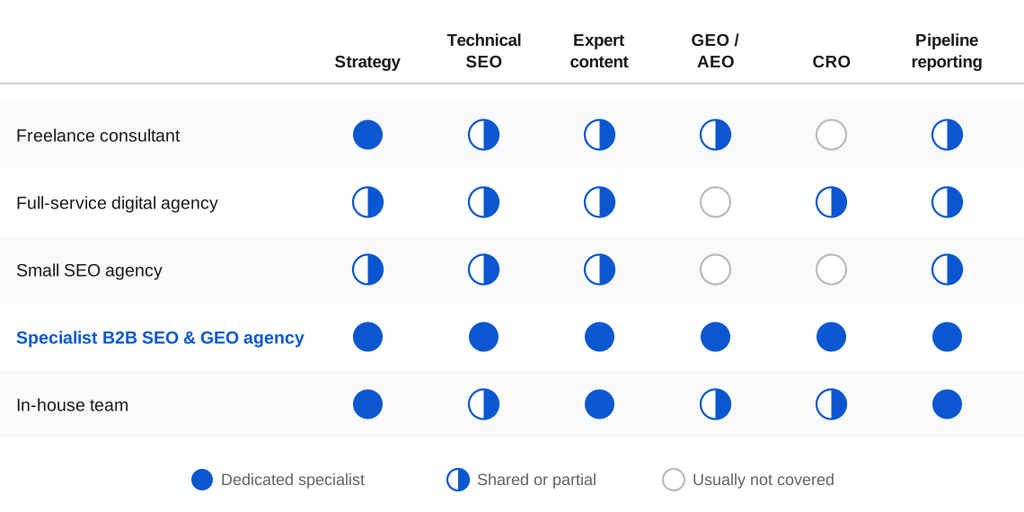
Figure 2: Typical specialist coverage by provider type. Individual providers vary, so use this as a starting point for your questions.
| Provider type | Typical team on your account | What you usually get | Best suited to |
|---|---|---|---|
| Freelance SEO consultant | One person, sometimes with subcontracted writers | Audits, strategy, on-page recommendations, limited content production | Early-stage companies needing direction, or teams with in-house execution |
| Full-service digital marketing agency | One or two generalists who also handle paid media or social | Technical audit, metadata updates, occasional blog posts | Businesses where SEO is a small part of a wider marketing mix |
| Small SEO agency | Account manager, generalist writer, part-time technical support | Ongoing optimization, regular content, basic reporting | Local or less competitive markets with modest content needs |
| Specialist B2B SEO and GEO agency | Strategist, technical specialist, SME writers, editor, GEO specialist, CRO and reporting support, account manager | Full strategy, technical SEO, expert content, AI search visibility, pipeline-level reporting | B2B SaaS and technology companies competing for high-value, technical keywords |
| In-house SEO team | SEO lead plus writers, often sharing developers and analysts with other teams | Deep product knowledge and close alignment with sales and product | Larger companies with steady budgets and long-term SEO commitment |
The key distinction is between agencies that treat SEO as a set of tasks and agencies that treat it as a growth channel. Task-based SEO can improve rankings a little. A growth channel needs strategy, content, technical work, and measurement all working together.
4. Pod Structure vs. Functional Structure
Beyond the roles themselves, agencies organize their people in one of two main ways.
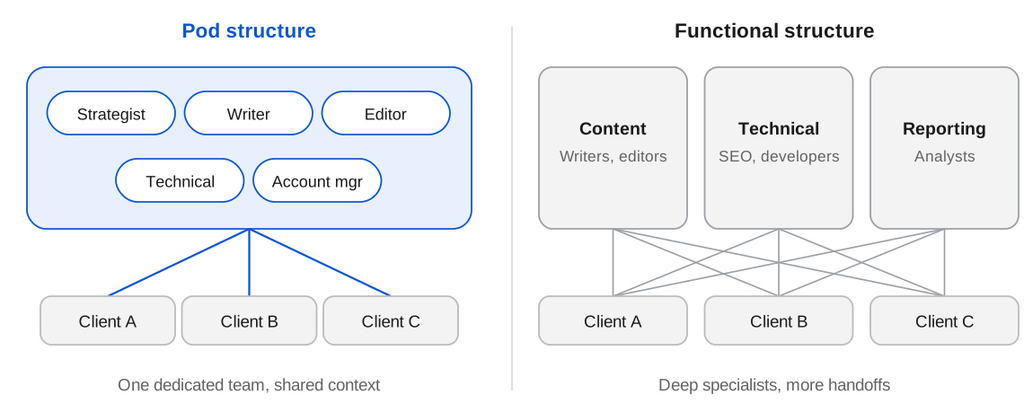
Figure 3: In a pod, one team owns a small group of clients. In a functional model, work moves between departments.
Pod structure
In a pod structure, a small, dedicated team works on a set group of clients. For example, one strategist, two writers, an editor, and an account manager might handle four or five accounts together.
Advantages: the team builds deep knowledge of your business, communication is faster, and there’s clear accountability.
Drawbacks: if a pod lacks a particular specialist, such as a technical SEO expert, that gap affects every client in the pod. Pods can also struggle when someone leaves.
Functional structure
In a functional structure, people are grouped by discipline. There’s a content department, a technical department, a reporting department, and so on. Work is passed between them for each client.
Advantages: each department builds deep expertise, and specialists can be shared across many accounts.
Drawbacks: handoffs can slow things down, and context gets lost between teams. Nobody may feel ownership of your overall results.
Which is better?
For most B2B companies, I’d lean toward a hybrid: a core pod that knows your business well, with access to specialists from the wider agency when needed. That gives you continuity without sacrificing expertise.
5. How Your Team Should Change as Your Company Grows
The right SEO team for a seed-stage startup isn’t the right team for an enterprise software company. Here’s how I’d think about it at different stages.
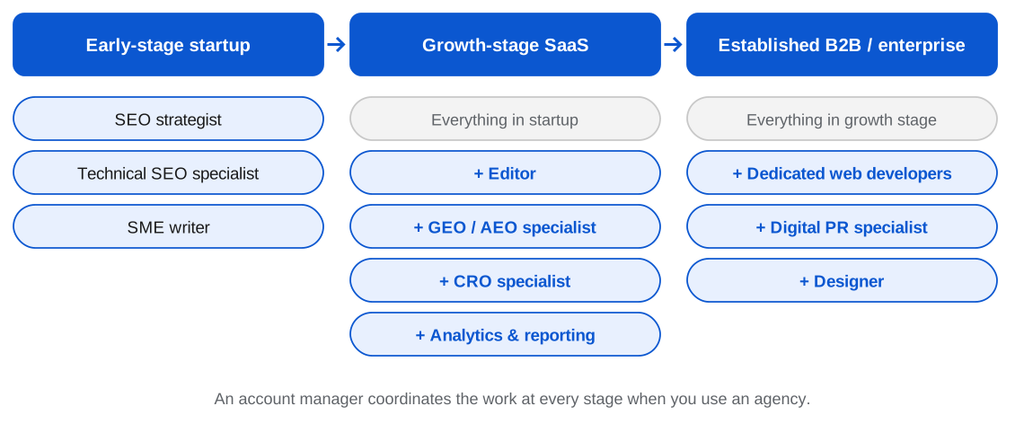
Figure 4: Roles to add as your company and SEO program grow. Highlighted items are new at each stage.
| Company stage | Main SEO priorities | Roles to prioritize |
|---|---|---|
| Early-stage startup | Technical foundation, core service and product pages, a small number of high-intent topics | Strategist, technical specialist, one strong SME writer |
| Growth-stage SaaS | Topical authority, comparison and alternative pages, conversion paths, AI search visibility | Add editor, GEO specialist, CRO and reporting support |
| Established B2B or enterprise | Large-scale technical health, multiple product lines, international SEO, authority building, attribution | Full team, often with dedicated developers and a digital PR function |
If you’re an early-stage company, you don’t need ten people on your account. But you do need the strategy to be right from the beginning. Fixing a poorly chosen content direction a year later is expensive.
Our work with startups usually starts with exactly that: getting the foundation and priorities right before scaling content.
6. In-House, Agency, or Hybrid?
This is one of the most common questions I hear from B2B marketing leaders.
Building in-house
An in-house team knows your product, customers, and sales process in a way an agency rarely can. Internal writers can interview product managers and engineers easily. Internal SEO leads can work closely with sales to understand which leads actually close.
The challenge is cost and coverage. Hiring a strategist, a technical specialist, two writers, an editor, a GEO specialist, and an analyst is a significant investment. Most companies end up with one or two generalists who have to cover everything.
Hiring an agency
An agency gives you access to several specialists without hiring each one. It also brings experience from other campaigns, which can help you avoid common mistakes.
The trade-off is that the agency needs time and input to understand your business. Without access to your subject-matter experts, even skilled agency writers can struggle with highly technical topics.
The hybrid model
Many B2B companies find a hybrid model works best. An internal SEO or content lead owns the strategy and connects the program to the business. An agency provides specialist execution, such as technical SEO, expert content, GEO, and reporting.
In my experience, this gives you the product knowledge of an in-house team with the depth of an agency.
A quick way to decide: if you can’t yet justify hiring at least three dedicated SEO specialists, an agency or hybrid model will usually give you more coverage for the same budget.
7. Questions to Ask an SEO Agency About Its Team
Google’s own guidance on hiring an SEO recommends asking providers about their experience, methods, and how they communicate. I’d go further and ask specifically about the team.
Here are the questions I’d ask:
- Who will work on our account, and what is each person responsible for? You want names and roles, not “our team.”
- Who decides which keywords and topics we target? The answer should be a strategist, not the writer or account manager.
- Who writes the content, and what do they know about our industry? Ask for writing samples on similar technical topics.
- Who handles technical SEO, and who implements the fixes? Find out whether you’ll need your own developers.
- How do you approach AI search visibility? Ask how they measure whether your brand appears in AI-generated answers.
- How do you report on results? Ask whether reporting goes beyond rankings to leads, opportunities, and pipeline.
- How stable is the team? Frequent turnover means you’ll keep re-explaining your business.
If you’d like a more complete checklist, our framework for evaluating an SEO strategy covers the strategic side in more depth.
Red flags to watch for
- The salesperson can’t tell you who will actually work on your account.
- One person handles strategy, writing, technical work, and reporting.
- Content is produced by writers with no experience in your industry, with no plan for SME input.
- Link building is described mainly in terms of volume.
- Reporting focuses only on rankings and traffic, with no connection to leads.
- Nobody on the team has a clear answer about AI search.
8. Choosing the Right SEO Team for Your Business
There’s no single perfect team structure. A small, focused team can outperform a large one if the strategy is right and every key responsibility has a capable owner.
But for most B2B companies competing on technical, high-value keywords, I’d expect a strong SEO partner like Techgranduer to cover five areas clearly: strategy, technical SEO, expert content, AI search visibility, and measurement tied to revenue.
If any of those are missing or combined into someone else’s job, I’d want to understand how the agency plans to cover it.
At TechGranduer, we bring SEO, AI search visibility, content, and web development together so that strategy, execution, and technical work stay connected. If you’re weighing up how to structure your own SEO program, we’d be happy to talk it through.
Frequently Asked Questions
How many people should be on an SEO agency team?
There is no fixed number. A focused B2B campaign usually needs somewhere between four and eight people contributing in some capacity, though not all of them work on the account full time. What matters more than headcount is whether strategy, content, technical SEO, and measurement are each owned by someone with real expertise.
What is the most important role on an SEO team?
The SEO strategist, because every other role depends on the decisions they make about which keywords and topics to pursue, what type of page each one needs, and how success will be measured. A great writer working on the wrong keyword still produces a page that does not generate business.
Should an SEO agency team include GEO or AI search specialists?
Increasingly, yes. B2B buyers now use AI assistants and AI-generated search answers to research vendors. Someone on the team should understand how those systems select and cite sources, and how to measure your brand’s visibility in them.
Is it better to build an in-house SEO team or hire an agency?
It depends on your budget, your timeline, and how much specialist depth you need. In-house teams offer deep product knowledge and close alignment with sales, while agencies give you access to several specialists without hiring each one. Many B2B companies use a hybrid model with an in-house owner and an agency for execution.
What questions should I ask an SEO agency about its team?
Ask who will work on your account, what each person is responsible for, who writes the content and what subject knowledge they have, who handles technical issues, how often the team changes, and how results are reported and tied to leads or pipeline.